
You’re shopping online, and the size guide is in centimeters. Your ruler only shows inches.
This happens all the time. Furniture, clothes, phone cases, luggage, and school projects often mix metric and imperial units.
The good news is that converting centimeters to inches is simple. Divide the number of centimeters by 2.54. That’s the whole formula.
This guide gives you everything in one place:
- A quick-reference chart
- The exact formula
- A step-by-step method
- A manual calculator you can use anywhere
- Worked examples for 1, 10, 25, 50, and 100 cm
- Real-life conversions for height, paper, screens, and luggage
- Short answers to common questions
Centimeters to Inches Conversion Chart
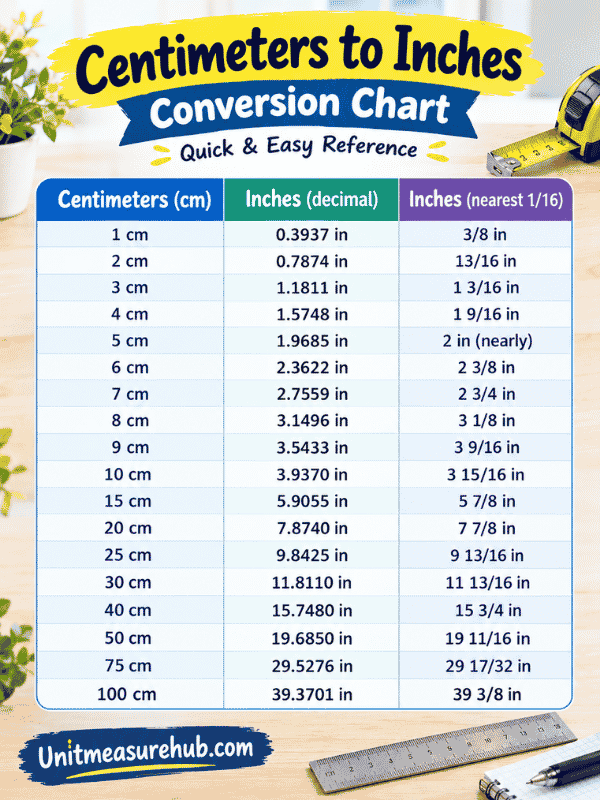
How to read this chart
- The decimal column is the most exact.
- The fraction column is what you’ll actually see on a tape measure.
- “Nearest 1/16” means the fraction is rounded, so it can be off by a tiny amount.
If your number isn’t listed, add two values together. For example, 35 cm is 30 cm plus 5 cm, so 11.811 + 1.9685 = 13.7795 inches.
How to Convert Centimeters to Inches
You can do this by hand in three steps. It works for any number, whole or decimal.
- Write down your length in centimeters. Example: 42 cm.
- Divide it by 2.54. 42 ÷ 2.54 = 16.5354.
- Round to the precision you need. For most tasks, two decimals is fine: 16.54 inches.
Doing it on a phone or calculator
Type the centimeters, press the divide key, type 2.54, and press equals. Done.
Some people prefer to multiply. You can, but you need the longer number: cm × 0.393701. Both methods give the same answer. Dividing by 2.54 is easier to remember, so it’s the one I’d stick with.
Getting a fraction instead of a decimal
Tape measures and rulers show fractions, not decimals. Here’s the method:
- Convert to decimal inches first.
- Keep the whole number. That’s your whole inches.
- Multiply the decimal part by 16.
- Round to the nearest whole number. That’s your sixteenths.
- Simplify the fraction if you can.
Example: 18 cm
- 18 ÷ 2.54 = 7.0866 inches
- Whole inches: 7
- Decimal part: 0.0866 × 16 = 1.39, which rounds to 1
- Result: 7 1/16 inches
Centimeters to Inches Formula
Here is the formula in its cleanest form:
inches = centimeters ÷ 2.54
Or in shorthand: in = cm / 2.54
The reverse formula is just as simple:
centimeters = inches × 2.54
Why 2.54
The number isn’t a rounded estimate. Since the international yard and pound agreement of 1959, one inch has been defined as exactly 2.54 centimeters.
The United States, United Kingdom, Canada, Australia, New Zealand, and South Africa agreed on it. That’s why every reliable converter uses the same figure.
The exact relationship
| Relationship | Value |
| 1 inch | 2.54 cm (exact) |
| 1 cm | 0.3937007874 in (rounded) |
| 1 cm as a fraction | about 25/64 in |
| 1 meter | 39.3701 in |
| 1 foot | 30.48 cm (exact) |
Centimeters to Inches Calculator
Manual calculator
Use this simple layout:
- Input: ______ cm
- Divide by: 2.54
- Output: ______ inches
Fill it in, press the keys, and you’re done. Any phone calculator does the job.
Quick multiplier method
| Shortcut | How to use it | Accuracy |
| Multiply by 0.4 | 50 cm × 0.4 = 20 in | About 1.6% too high |
| Multiply by 4, then move the decimal | 50 × 4 = 200, so 20 in | Same as above |
| Multiply by 0.4, subtract 1.5% | 20 − 0.3 = 19.7 in | Very close |
Calculator inside a spreadsheet
In Excel or Google Sheets, put your centimeters in cell A1. In cell B1, type:
=A1/2.54
Drag it down to convert a whole column. You can also use the built-in function =CONVERT(A1,”cm”,”in”).
1 cm to Inches Conversion
1 cm = 0.3937 inches
As a fraction, that’s roughly 25/64 of an inch, or just under 3/8 inch on a standard ruler.
The math: 1 ÷ 2.54 = 0.393701
What does 1 cm look like?
It’s about the width of a fingernail, a pencil’s diameter, or a standard staple. Most adults have a pinky finger close to 1 cm wide.
Why does this small unit matter?
Small errors add up. If you use 0.4 instead of 0.3937 on a 1 cm measurement, you’re off by only 0.006 inches. That’s nothing.
But on a 200 cm door frame, the same shortcut is off by 1.26 inches. Small differences grow quickly on larger measurements.
Useful 1 cm facts
- 1 cm = 10 millimeters
- 1 cm = 0.01 meters
- 1 inch is about 2.5 times longer than 1 cm
10 cm to Inches Conversion
10 cm = 3.937 inches, or about 3 15/16 inches
The math: 10 ÷ 2.54 = 3.937008
The easy memory trick
10 cm is almost exactly 4 inches. It’s only 0.063 inches short. That’s about the thickness of two credit cards stacked together.
For casual use, calling it 4 inches is fine.
Where you’ll see 10 cm
- A small smartphone is about 7 cm wide, so 10 cm is roughly a phone’s width plus a thumb.
- A standard business card is 9 cm long, so 10 cm is just a bit longer.
- Seedling pots, gift tags, and small picture frames often list sizes in multiples of 10 cm.
Step-by-step
- Take 10 cm.
- Divide by 2.54.
- Result: 3.937 inches.
- Round if needed: 3.94 in, or 3 15/16 in.
25 cm to Inches Conversion
25 cm = 9.8425 inches, or about 9 13/16 inches
The math: 25 ÷ 2.54 = 9.842520
The easy memory trick
25 cm is close to 10 inches, but it falls short by about 0.16 inches. That’s roughly 5/32 of an inch.
If you’re buying a 10-inch item and the listing says 25 cm, it’s a match for most purposes.
Where you’ll see 25 cm
- Dinner plates and cake pans are often 25 cm across.
- Kitchen tiles, notebooks, and baby toys use this size.
- Many European product listings use 25 cm where American ones say 10 inches.
Quarter-meter shortcut
25 cm is exactly one quarter of a meter. Since a meter is 39.37 inches, a quarter of that is 9.8425 inches. Same answer, different route.
50 cm to Inches Conversion
50 cm = 19.685 inches, or about 19 11/16 inches
The math: 50 ÷ 2.54 = 19.685039
The easy memory trick
50 cm is just under 20 inches. It’s off by 0.315 inches, about 5/16 of an inch.
Half a meter
Since 50 cm is half a meter, you can also halve 39.3701 to get 19.685. Both methods give the same answer.
Where you’ll see 50 cm
- Newborn babies average around 50 cm at birth, which is about 19.7 inches.
- Standard suitcases and carry-on sizes often list one side near 50 cm.
- Desk depth, shelf width, and bike frame sizes commonly land near this figure.
Common mistake to avoid
Don’t round 50 cm to 20 inches for items that must fit precisely. A 0.3-inch gap can be the difference between a shelf fitting or not.
100 cm to Inches Conversion
100 cm = 39.3701 inches, or about 39 3/8 inches
The math: 100 ÷ 2.54 = 39.370079
100 cm equals 1 meter
That makes this conversion useful as a reference for everything else. One meter is 39.37 inches, which is about 3 feet 3 3/8 inches.
Feet and inches breakdown
- 39.3701 ÷ 12 = 3.28 feet
- 3 feet = 36 inches
- 39.3701 − 36 = 3.3701 inches
- Result: 3 ft 3.37 in
Where you’ll see 100 cm
- Toddler height, table height, and countertop measurements
- Fabric sold by the meter
- Curtain lengths, rope, and cable
One meter versus one yard
A meter is a little longer than a yard. The yard is 36 inches, and the meter is 39.37 inches. That’s a difference of 3.37 inches. It’s a common trap when buying fabric abroad.
Centimeters to Inches Conversion Table
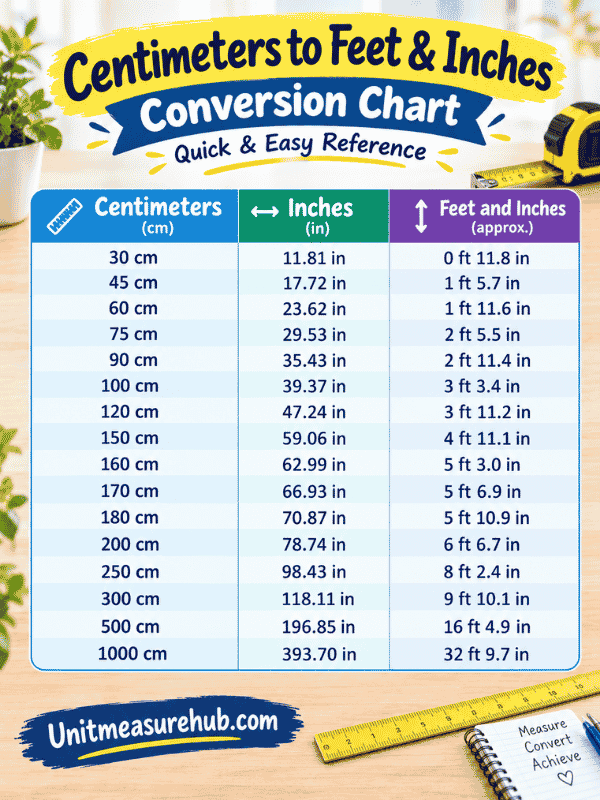
inches to centimeters
Sometimes you need to go the other way. Multiply by 2.54.
| Inches | Centimeters |
| 1 in | 2.54 cm |
| 6 in | 15.24 cm |
| 12 in (1 ft) | 30.48 cm |
| 24 in (2 ft) | 60.96 cm |
| 36 in (1 yd) | 91.44 cm |
Common Centimeter to Inch Conversions
Human height (cm to feet and inches)
This is one of the most searched conversions. Divide by 2.54 to get total inches, then divide by 12 for feet.
| Height (cm) | Total Inches | Feet and Inches |
| 150 cm | 59.1 in | 4 ft 11 in |
| 155 cm | 61.0 in | 5 ft 1 in |
| 160 cm | 63.0 in | 5 ft 3 in |
| 165 cm | 65.0 in | 5 ft 5 in |
| 170 cm | 66.9 in | 5 ft 7 in |
| 175 cm | 68.9 in | 5 ft 9 in |
| 180 cm | 70.9 in | 5 ft 11 in |
| 185 cm | 72.8 in | 6 ft 1 in |
| 190 cm | 74.8 in | 6 ft 3 in |
| 195 cm | 76.8 in | 6 ft 5 in |
Paper and print sizes
| Item | Size in cm | Size in inches |
| A4 paper | 21 × 29.7 cm | 8.27 × 11.69 in |
| US Letter | 21.59 × 27.94 cm | 8.5 × 11 in |
| Passport photo | 3.5 × 4.5 cm | 1.38 × 1.77 in |
| 10 × 15 cm photo | 10 × 15 cm | 3.94 × 5.91 in |
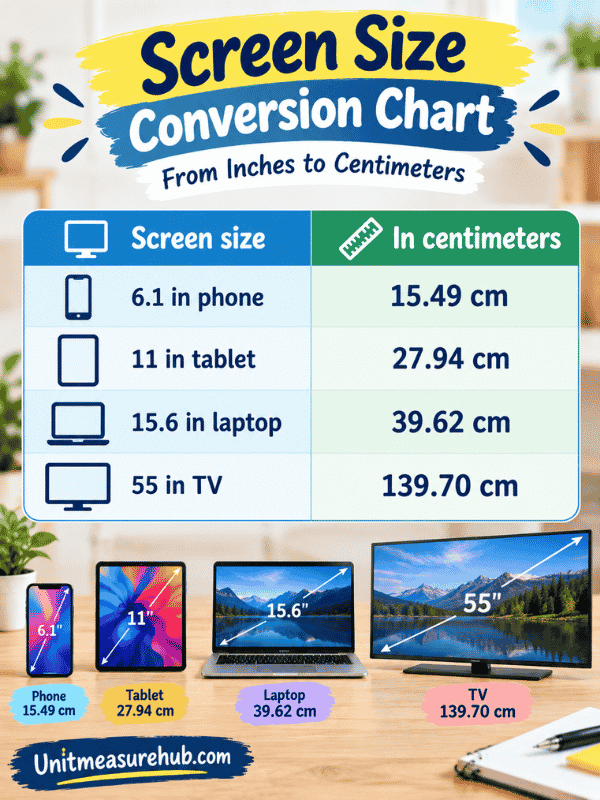
Screens and devices
Screen sizes are usually quoted in inches, even in metric countries. To go from inches to centimeters, multiply by 2.54.
Luggage and cabin bags
Airlines love centimeters. A common cabin bag limit is 55 × 40 × 20 cm, which is about 21.7 × 15.7 × 7.9 inches.
Always check your airline’s exact rules. Limits vary, and some include wheels and handles in the measurement.
Home and furniture
- A standard interior door is about 200 cm tall, or 78.7 inches.
- A dining table is often 75 cm high, or 29.5 inches.
- A yoga mat of 183 cm is about 72 inches, or exactly 6 feet.
Clothing and body measurements
Waist, chest, and hip sizes often appear in both units on size charts. To convert quickly, divide by 2.54.
For example, a 76 cm waist is 29.9 inches, and a 91 cm chest is 35.8 inches.
Brand sizing varies, so always compare against the brand’s own chart when you can.
Common Mistakes to Avoid
Multiplying instead of dividing
If your inch value is bigger than your cm value, you flipped it.
Using 2.5 instead of 2.54
On 100 cm, that gives 40 inches instead of 39.37, a gap of over half an inch.
Rounding too early
Round once, at the end.
Confusing decimal inches with fractions
7.5 inches is 7 1/2 inches, but 7.25 inches is 7 1/4 inches, not 7 2/5.
Mixing up inches and feet
5.5 feet is 5 feet 6 inches, not 5 feet 5 inches.
Frequently Asked Questions
How do you convert centimeters to inches?
Divide the centimeters by 2.54. For example, 50 ÷ 2.54 = 19.69 inches.
What is the formula for cm to inches?
Inches = centimeters ÷ 2.54. You can also multiply by 0.393701.
How many inches are in 1 cm?
There are 0.3937 inches in 1 cm, or about 25/64 of an inch.
How many inches is 10 cm?
10 cm equals 3.937 inches, roughly 3 15/16 inches.
How many inches is 25 cm?
25 cm equals 9.84 inches, close to 10 inches.
How many inches is 50 cm?
50 cm equals 19.69 inches, just under 20 inches.
How many inches is 100 cm?
100 cm equals 39.37 inches, or 3 feet 3.4 inches.
Why is 2.54 used for the conversion?
One inch is officially defined as exactly 2.54 cm, so the factor is exact, not an estimate.
Is 1 inch bigger than 1 cm?
Yes. One inch is 2.54 times longer than one centimeter.
How do I convert cm to feet and inches?
Divide by 2.54 for total inches, then divide by 12. The whole number is feet, and the remainder is inches.
What is a quick way to estimate cm to inches?
Multiply by 0.4. It runs about 1.6% high, so it’s fine for rough estimates only.
How do I convert cm to inches as a fraction?
Convert to decimal inches, multiply the decimal part by 16, and round. The result is your sixteenths.
How do I convert inches back to centimeters?
Multiply the inches by 2.54. For example, 12 inches × 2.54 = 30.48 cm.
Also Read This Inches to Feet Conversion Chart, Formula & Calculator
Conclusion
Converting centimeters to inches comes down to one step: divide by 2.54.
Everything else in this guide builds on that. The chart saves time on common values, and the fraction method helps when you’re working with a ruler or tape measure. The worked examples for 1, 10, 25, 50, and 100 cm give you reference points to check any result against.
Here’s the short version to remember:
- 1 cm ≈ 0.39 inches
- 10 cm ≈ 3.94 inches
- 25 cm ≈ 9.84 inches
- 50 cm ≈ 19.69 inches
- 100 cm ≈ 39.37 inches
For everyday shopping, the 0.4 shortcut works. For anything you’ll cut, build, or order custom, use the exact formula and round at the end.

My name is simith .iam passionate writer With 4 years of experience, we make measurements easy and accurate. Our focus is on unit, length, and weight conversions. Our goal is to make everyday conversions quick and hassle-free.