
You are halfway through a recipe when it hits you. The ingredient list is in grams, but your scale only shows ounces. Or maybe you are shipping a parcel, tracking your protein intake, or weighing coffee beans, and the numbers just do not match.
This guide fixes that. You will find a clear grams to ounces conversion chart, the exact formula, quick mental shortcuts, and real examples from the kitchen and beyond. Everything here uses the standard international values, so you can trust every number.
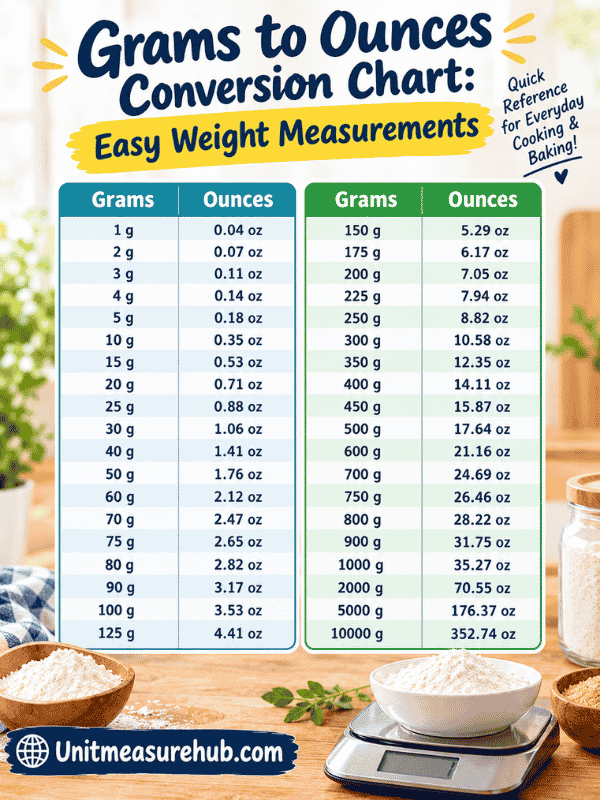
Grams to Ounces Conversion Chart
| Grams (g) | Ounces (oz) |
| 1 g | 0.04 oz |
| 5 g | 0.18 oz |
| 10 g | 0.35 oz |
| 25 g | 0.88 oz |
| 28.35 g | 1.00 oz |
| 50 g | 1.76 oz |
| 100 g | 3.53 oz |
| 250 g | 8.82 oz |
| 500 g | 17.64 oz |
| 1000 g | 35.27 oz |
How to Convert Grams to Ounces
Method 1: Divide by 28.35
- Write down the weight in grams.
- Divide it by 28.3495 (or 28.35 for everyday use).
- The answer is the weight in ounces.
Method 2: Multiply by 0.035274
- Write down the weight in grams.
- Multiply it by 0.035274.
- Round the result to the precision you need.
Both methods give the same answer. Multiplication is easier on a phone calculator because the number is shorter to type in your head. Division is easier if you already remember that one ounce equals about 28 grams.
A Worked Example
Let’s convert 340 grams of honey to ounces.
- 340 × 0.035274 = 11.99 oz
- Check by division: 340 ÷ 28.3495 = 11.99 oz
So 340 grams is almost exactly 12 ounces. That is why many honey jars are sold in that size.
Grams to Ounces Conversion Formula
The formula is simple and exact. It rests on the international agreement that defines one avoirdupois ounce as 28.349523125 grams.
Formula:
Ounces = Grams ÷ 28.3495
Or, the reverse way:
Ounces = Grams × 0.035274
And if you need to go back the other direction:
Grams = Ounces × 28.3495
Why 28.3495?
The ounce comes from the old English pound system. Since 1959, the pound has been defined as exactly 0.45359237 kilograms. One pound holds 16 ounces, so one ounce equals 453.59237 ÷ 16 grams, which is 28.349523125 grams. Every serious conversion tool uses this number.
Handy Shortcuts for Mental Math
No calculator nearby? Try these tricks:
- Round to 28: Divide the grams by 28. It is close enough for most kitchen work.
- Use 30 for rough guesses: Divide by 30 and add a small bit. Good for quick estimates only.
- Use 100 g ≈ 3.5 oz: Scale up or down from there. 200 g is about 7 oz, and 300 g is about 10.5 oz.
- Think in pounds: 454 g is one pound, or 16 oz. Half of that is 227 g, or 8 oz.
Using Spreadsheets
You can convert whole lists of weights in seconds.
- Excel or Google Sheets: =A1/28.3495
- Built-in function: =CONVERT(A1,”g”,”ozm”)
Replace A1 with the cell that holds your gram value. Drag the formula down to convert a full column.
Grams to Ounces Calculator
An online grams to ounces calculator is the fastest way to get an exact answer. You type in the grams, and the tool returns ounces instantly. Search engines and most phones have one built in. Just type something like “250 g to oz” in the search bar.
But you do not need a special tool. Your phone’s regular calculator works fine.
How to Use Your Phone Calculator
- Open the calculator app.
- Type the gram amount.
- Press the multiplication key.
- Enter 0.035274.
- Press equals.
Digital Kitchen Scales
Most modern kitchen scales switch between units with a single button. Look for “g” and “oz” on the display. If your scale has this feature, you can weigh ingredients directly in either unit. There is no need to convert at all.
Use the tare (zero) button after placing your bowl on the scale. That way you only measure the ingredient, not the container.
When a Calculator Beats a Chart
- You have an unusual number like 173 g or 2,847 g.
- You need three or more decimals.
- You are converting many values at once.
For common amounts, the chart on this page is faster.
How Many Ounces Are in a Gram?
One gram equals 0.035274 ounces. That is a very small amount, a bit more than three hundredths of an ounce.
To picture it, think of a standard paperclip. A regular paperclip weighs about one gram. A sugar packet from a cafe weighs around four grams.
- 1 ounce = 28.3495 grams
- 1 pound = 453.592 grams
- 1 kilogram = 35.274 ounces
- 1 kilogram = 2.2046 pounds
Because a gram is so tiny, recipes and nutrition labels often use grams for small amounts. Ounces feel more natural for larger portions, such as a steak or a bag of chocolate chips.
Grams to Ounces Conversion Table
Grams to Pounds and Ounces
| Grams | Pounds and Ounces |
| 227 g | 0 lb 8 oz |
| 454 g | 1 lb 0 oz |
| 500 g | 1 lb 1.6 oz |
| 750 g | 1 lb 10.5 oz |
| 1000 g | 2 lb 3.3 oz |
| 1500 g | 3 lb 4.9 oz |
| 2000 g | 4 lb 6.5 oz |
100 Grams to Ounces
100 grams equals 3.53 ounces.
This is one of the most searched conversions, and for good reason. Nutrition labels list values per 100 grams in most countries. If you track food in ounces, this number is your anchor.
Here is how 100 grams looks in real foods:
- About 100 g of cooked rice is a small scoop, roughly half a cup.
- About 100 g of cheddar cheese is a thick slice the size of a deck of cards.
- About 100 g of chicken breast is a small portion, a bit under four ounces.
To scale the number, multiply by the same factor. 200 g is 7.05 oz, and 300 g is 10.58 oz.
250 Grams to Ounces
250 grams equals 8.82 ounces.
This is just under nine ounces, and just over half a pound (8 oz). Many European recipes use 250 g as a standard pack size. Butter blocks, mascarpone tubs, and pasta packs often come at this weight.
A few examples:
- A 250 g block of butter is about 8.8 oz.
- A 250 g pack of mascarpone for tiramisu is about 8.8 oz.
- A 250 g bag of coffee beans is a common size in specialty roasters.
If a recipe asks for 250 g and you only have ounces, 9 oz is close enough for most dishes. For baking, aim for 8.8 oz.
500 Grams to Ounces
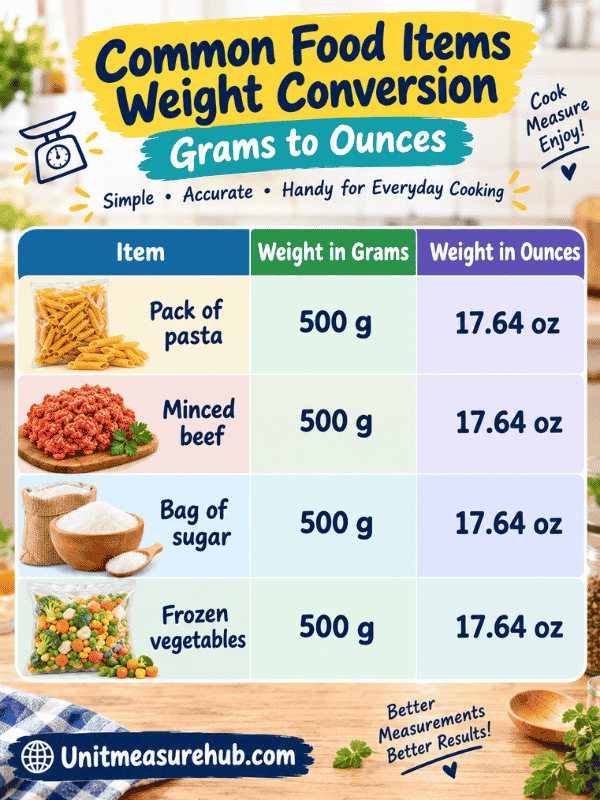
500 grams equals 17.64 ounces.
That is just over one pound. A pound is 16 ounces, so 500 g sits at 1 lb and 1.6 oz.
This weight is everywhere. Half-kilo bags of flour, pasta, sugar, and minced meat all use it. Because it is slightly more than a pound, recipes written for 1 lb often work with 450 g instead. Using 500 g adds a little extra, which is usually fine in stews and sauces but may matter in baking.
1000 Grams to Ounces
1000 grams equals 35.27 ounces.
One kilogram is the same as 2.2 pounds, or 2 pounds and 3.3 ounces. If you are weighing a big bag of rice, a whole chicken, or a bag of potatoes, this is the figure you need.
It also helps with luggage and shipping. Many airlines and couriers list limits in kilograms, while some scales show ounces. A 23 kg bag, for instance, is 811.3 oz, or about 50.7 pounds.
To convert kilograms to ounces, multiply by 35.274.
Grams to Ounces Conversion for Cooking
In most of the world, cooks weigh ingredients in grams. In the United States, recipes still lean on cups, spoons, and ounces. If you cook from international blogs or cookbooks, you will switch between the two often.
Weighing is more reliable than measuring by volume. A cup of flour can weigh anywhere from 120 g to 150 g depending on how you scoop it. A scale removes that guesswork.
Common Cooking Conversions
| Ingredient | Grams | Ounces |
| 1 tablespoon butter | 14 g | 0.5 oz |
| 1 stick of butter | 113 g | 4 oz |
| 1 cup shredded cheese | 113 g | 4 oz |
| 1 cup uncooked rice | 185 g | 6.5 oz |
| 1 cup rolled oats | 90 g | 3.2 oz |
| 1 cup milk or water | 237 g | 8.4 oz |
| 1 cup honey | 340 g | 12 oz |
| 1 cup chocolate chips | 170 g | 6 oz |
Meat and Protein Portions
Meat is usually sold by weight, so ounce conversions come up often.
- 113 g of raw meat is 4 oz, a standard serving size.
- 150 g of chicken breast is 5.3 oz.
- 225 g of steak is about 8 oz.
- 450 g of ground beef is about 16 oz, or 1 lb.
Also Read This Kitchen Measurement Conversion Guide: Cups, Spoons & Ounces
Tips for Accurate Cooking Conversions
- Use a digital scale with both units.
- Weigh dry ingredients first, then liquids.
- Use the tare button between ingredients.
- Do not mix fluid ounces and weight ounces.
- Write the converted amounts on your recipe card for next time.
Grams to Ounces for Baking Ingredients
Baking is chemistry. A small error in flour or sugar can change the rise, crumb, and texture. That is why professional bakers weigh everything in grams.
If your recipe is in grams and your scale is in ounces, convert carefully and keep two decimals.
Baking Ingredient Conversion Chart
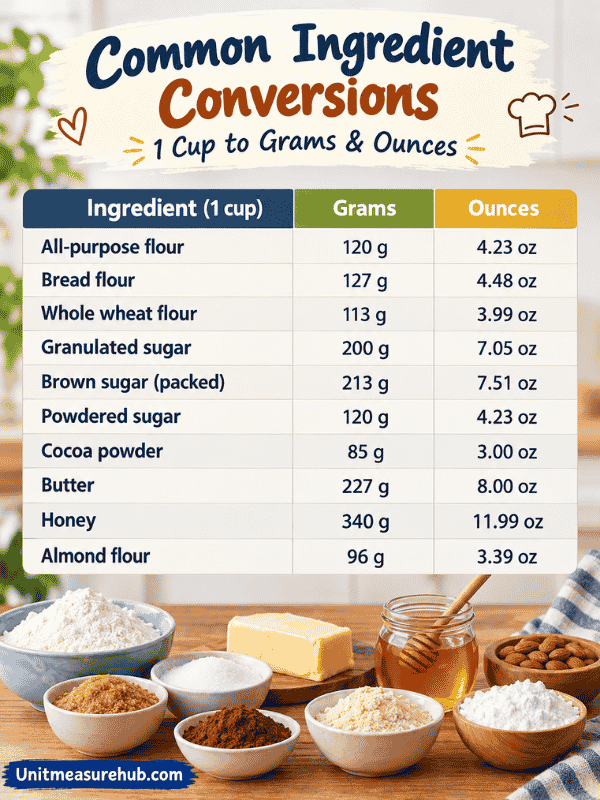
Flour weights vary by source. King Arthur Baking, for instance, lists all-purpose flour at 120 g per cup, while some other sources use 125 g. Pick one standard and stay with it through a recipe.
Small Baking Amounts
| Ingredient | Grams | Ounces |
| 1 tsp baking powder | 4 g | 0.14 oz |
| 1 tsp baking soda | 5 g | 0.18 oz |
| 1 tsp table salt | 6 g | 0.21 oz |
| 1 packet active dry yeast | 7 g | 0.25 oz |
Common Baking Mistakes to Avoid
Scooping flour with the cup
This packs it down and adds up to 30 percent extra.
Rounding too early
Convert the full amount, then round at the end.
Ignoring humidity
Flour absorbs moisture, which slightly changes weight.
Grams vs. Ounces: What’s the Difference?
| Feature | Gram (g) | Ounce (oz) |
| System | Metric | Imperial / US customary |
| Symbol | g | oz |
| Size | Smaller unit | Larger unit |
| Equivalent | 1 g = 0.0353 oz | 1 oz = 28.35 g |
| Used in | Most countries worldwide | United States, partly the UK |
| Best for | Precise, small amounts | Larger portions, everyday use |
| Related units | Kilogram, milligram | Pound (16 oz) |
Why the Metric System Is Easier
The metric system uses powers of ten. A kilogram is 1,000 grams, and a gram is 1,000 milligrams. There is nothing to memorize beyond that.
The imperial system is less tidy. One pound holds 16 ounces, and a stone holds 14 pounds. Switching between them takes more steps.
Weight Ounces vs. Fluid Ounces
This is a very common source of mistakes.
- Weight ounces (oz) measure mass.
- Fluid ounces (fl oz) measure volume.
They are not the same thing. One fluid ounce of water weighs about 29.6 grams, while one weight ounce is 28.35 grams. For thick or light ingredients like honey or flour, the gap is much bigger.
If a recipe says “8 oz of flour,” it almost always means weight. If it says “8 fl oz of milk,” it means volume.
Common Grams to Ounces Conversion Examples
Numbers are easier to remember with real situations. Here are practical examples from daily life.
In the Kitchen
- 18 grams of coffee for a single espresso shot is 0.64 oz.
- 30 grams of dark chocolate is 1.06 oz, a small snack square.
- 85 grams of cheese is 3 oz, a good serving for a sandwich.
At the Store and Post Office
- A 400 g can of beans is 14.1 oz, which is why many cans say 14 oz.
- A 200 g chocolate bar is 7.05 oz.
- A 100 g letter parcel is 3.53 oz, helpful for postage tiers.
Health and Fitness
- 150 g of cooked chicken is 5.29 oz.
- 30 g of protein powder (one scoop) is 1.06 oz.
- A 3,500 g newborn weighs 123.5 oz, or 7 lb 11.5 oz.
Crafts and Hobbies
- 50 g of yarn is 1.76 oz, a common skein size.
- 100 g of candle wax is 3.53 oz.
- 5 g of gold is 0.18 oz, though troy ounces apply for pricing.
Quick Practice Problems
- Convert 320 g of flour to ounces. (Answer: 11.29 oz)
- Convert 75 g of butter to ounces. (Answer: 2.65 oz)
- Convert 1,250 g of potatoes to ounces. (Answer: 44.09 oz)
Frequently Asked Questions
How do you convert grams to ounces?
Divide the grams by 28.3495, or multiply them by 0.035274. The result is the weight in ounces.
How many ounces are in 100 grams?
100 grams equals 3.53 ounces.
How many ounces are in 250 grams?
250 grams equals 8.82 ounces.
How many ounces are in 500 grams?
500 grams equals 17.64 ounces, or just over 1 pound.
How many ounces are in 1000 grams?
1000 grams (1 kg) equals 35.27 ounces.
How many grams are in one ounce?
One ounce equals 28.3495 grams, usually rounded to 28.35 g.
What is the easiest way to convert grams to ounces in your head?
Divide the grams by 28 for a close estimate. Remember that 100 g is about 3.5 oz.
Is a gram bigger than an ounce?
No. An ounce is about 28 times heavier than a gram.
Are weight ounces and fluid ounces the same?
No. Weight ounces measure mass, and fluid ounces measure volume.
How many grams are in a pound?
One pound equals 453.59 grams, or 16 ounces.
Why do recipes use grams instead of ounces?
Grams are smaller and more precise, which helps with accurate baking.
Is a troy ounce the same as a regular ounce?
No. A troy ounce is 31.1035 grams, while a regular ounce is 28.3495 grams.
Also Read This Tablespoons to Cups Conversion: Easy US Kitchen Measurement Chart
Conclusion
Converting grams to ounces does not need to be hard. Divide by 28.3495 or multiply by 0.035274, and you will get an exact answer every time. For quick checks, remember that 100 grams is about 3.5 ounces, 250 grams is 8.8 ounces, 500 grams is 17.6 ounces, and 1,000 grams is 35.3 ounces.
Use the charts above when you are in a hurry. Use a digital scale when accuracy counts, especially in baking. And always check whether a recipe means weight ounces or fluid ounces before you start measuring.

My name is simith .iam passionate writer With 4 years of experience, we make measurements easy and accurate. Our focus is on unit, length, and weight conversions. Our goal is to make everyday conversions quick and hassle-free.