
If you’ve ever stared at a recipe that lists “250 grams of flour” while your measuring cups sit uselessly on the counter, you know the frustration. Most American kitchens are stocked with cup and spoon measures, while recipes from Europe, the UK, Australia, and professional baking blogs almost always use grams. The result? A lot of guesswork, and a lot of baking disasters.
The truth is, there’s no single number that converts grams to cups for every ingredient. A cup of flour and a cup of honey don’t weigh the same, because grams measure weight and cups measure volume. Once you understand that one simple idea, the rest becomes easy.
This guide gives you a complete grams to cups conversion chart for the most common baking and cooking ingredients, explains the formula behind every conversion, and answers the specific gram amounts people search for most like 100 grams to cups and 250 grams to cups. Whether you’re converting a family recipe or following a cookbook from abroad, you’ll have everything you need right here, without needing a calculator, a chemistry degree, or a second trip to the store because your cake came out wrong.
Home bakers run into this problem constantly. You find a beautiful sourdough recipe on a British food blog, a rich chocolate cake from a French pâtisserie, or your grandmother’s handwritten notes from overseas, and every single quantity is listed in grams. Meanwhile, your measuring cups are sitting right there, unused, because you don’t know how the two systems relate. This article solves that problem permanently by giving you both the exact numbers and the reasoning behind them, so you’re never stuck guessing again.
Why Grams Are More Accurate Than Cups
Before jumping into the charts, it helps to understand why so many professional bakers and international recipes rely on grams instead of cups in the first place.
A cup is a measurement of volume — how much space an ingredient takes up. A gram is a measurement of weight — how heavy that ingredient actually is. These two things sound similar, but they behave very differently in the kitchen.
Think about flour. If you scoop a cup directly from the bag, the flour gets compressed and you end up with more flour than the recipe intended — sometimes 20-25 grams more per cup. If you spoon it in lightly and level it off, you get a completely different amount. The cup measurement hasn’t changed, but the actual weight of flour in it has changed significantly. This is exactly why two people using “1 cup of flour” from the same recipe can end up with noticeably different baked goods.
Grams eliminate this inconsistency entirely. A gram of sugar is always a gram of sugar, whether it’s humid or dry, packed or loose, measured by a professional pastry chef or a first-time baker. That’s why weight-based measuring is considered the gold standard in professional kitchens and why so many serious home bakers eventually switch to a digital kitchen scale.
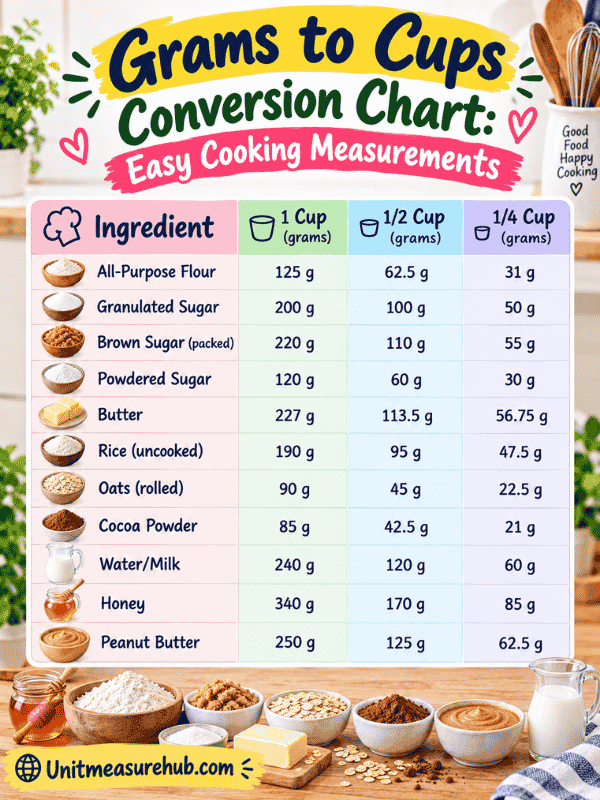
Grams to Cups Conversion Chart for Common Ingredients
How to Convert Grams to Cups Easily
- Identify the ingredient. Different ingredients pack differently into a cup, so the gram value per cup changes from one to another.
- Find the grams-per-cup value for that specific ingredient (use the chart above or a density reference).
- Divide the total grams by the grams-per-cup value to get your answer in cups.
- Use a kitchen scale whenever possible. It’s the most accurate way to measure ingredients and removes the guesswork entirely.
- Spoon and level dry ingredients like flour and sugar into your cup rather than scooping directly from the bag, which can compact the ingredient and throw off your measurement.
- Pack brown sugar firmly into the cup, since it’s meant to be measured densely — this is different from how you’d measure white sugar.
- Room temperature matters for butter and honey. Softened butter and warm honey measure more consistently than cold, hard versions.
- Round sensibly. Home baking rarely needs the same precision as a chemistry lab; rounding to the nearest quarter cup is usually fine.
Grams to Cups Formula: How the Conversion Works
If you want to convert any ingredient — even one not listed in a chart — this is the formula professional recipe developers use:
Cups = Grams ÷ (Density of Ingredient in g/ml × Volume of Cup in ml)
In simpler terms:
Cups = Grams ÷ Grams per Cup
The standard US cup holds 236.6 ml (often rounded to 240 ml for easy math). Since every ingredient has its own density, the “grams per cup” figure changes for each one. Water is the easiest reference point because its density is almost exactly 1 gram per milliliter, meaning 1 cup of water weighs about 240 grams.
Example
Let’s say you need to convert 180 grams of all-purpose flour into cups.
- Grams per cup for flour: 125 g
- Formula: 180 ÷ 125 = 1.44 cups
So 180 grams of flour is approximately 1 ½ cups when rounded to a practical baking measurement.
Common Mistakes When Converting Grams to Cups
Using one universal conversion for every ingredient
The single biggest mistake is assuming 1 cup always equals the same number of grams. It doesn’t — a cup of feathery cocoa powder and a cup of dense honey are worlds apart in weight.
Ignoring the difference between “packed” and “loose” measurements
Brown sugar, herbs, and shredded cheese are often measured packed, while flour and cocoa powder are usually measured loose. Mixing these up throws off your results.
Not accounting for sifted vs. unsifted flour
Sifted flour is lighter and airier, so a cup of sifted flour weighs less than a cup of unsifted flour, even though the volume looks the same.
Assuming all cup sizes are identical worldwide
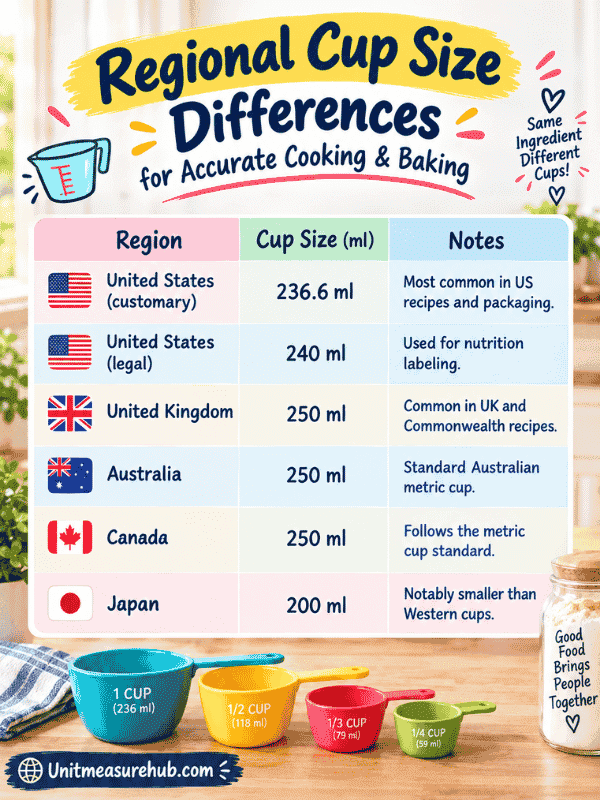
As covered in the section below, the US, UK, and Australian cup sizes are all slightly different, which can matter in precision baking.
Forgetting that liquid and dry measuring cups aren’t interchangeable
Liquid measuring cups are designed to be filled to a line below the rim to prevent spills, while dry measuring cups are meant to be leveled flush with the top.
Rounding too aggressively
For everyday cooking, rounding to the nearest quarter cup is fine, but for delicate recipes like macarons, soufflés, or bread with hydration ratios, small rounding errors can add up.
Regional Cup Size Differences
Grams to Cups Conversion for Flour
| Grams | Cups (approx.) |
| 30 g | 1/4 cup |
| 60 g | 1/2 cup |
| 90 g | 3/4 cup |
| 125 g | 1 cup |
| 190 g | 1 1/2 cups |
| 250 g | 2 cups |
| 375 g | 3 cups |
| 500 g | 4 cups |
It’s also worth knowing that not all flours convert the same way. Bread flour, cake flour, and whole wheat flour all have slightly different densities compared to standard all-purpose flour:
| Flour Type | Grams per Cup |
| All-Purpose Flour | 125 g |
| Bread Flour | 127 g |
| Cake Flour | 114 g |
| Whole Wheat Flour | 120 g |
| Self-Rising Flour | 125 g |
| Almond Flour | 96 g |
Cake flour is noticeably lighter than all-purpose flour because it’s milled finer and has lower protein content, while whole wheat flour includes the bran and germ, which affects its weight-to-volume ratio slightly. If a recipe doesn’t specify which flour type was used to calculate its gram measurements, all-purpose flour is generally the safest assumption.
Grams to Cups Conversion for Sugar
| Sugar Type | Grams per Cup |
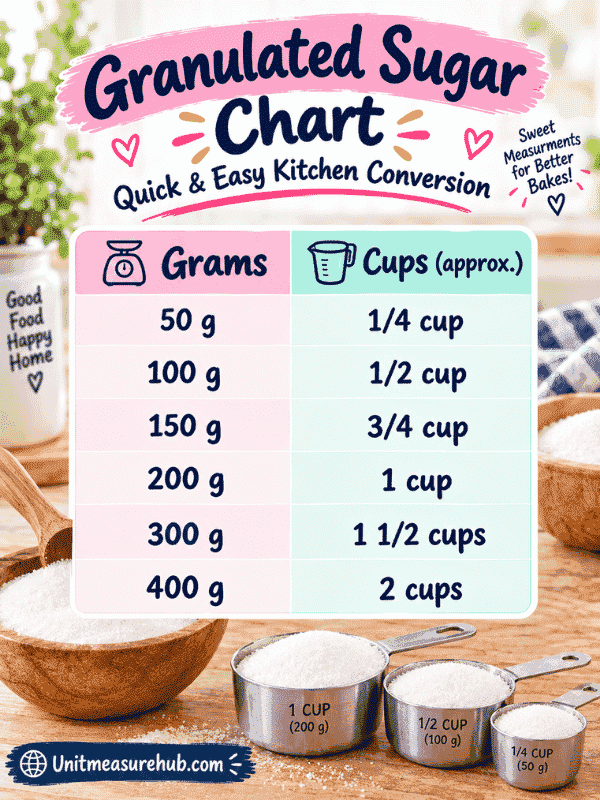
| Granulated White Sugar | 200 g |
| Brown Sugar (packed) | 220 g |
| Powdered/Confectioners’ Sugar | 120 g |
| Caster Sugar (superfine) | 225 g |
Granulated Sugar Chart
Grams to Cups Conversion for Butter
| Grams | Cups (approx.) | Sticks of Butter |
| 57 g | 1/4 cup | 1/2 stick |
| 113 g | 1/2 cup | 1 stick |
| 170 g | 3/4 cup | 1 1/2 sticks |
| 227 g | 1 cup | 2 sticks |
| 454 g | 2 cups | 4 sticks (1 lb) |
100 Grams to Cups: Quick Conversion Guide
| Ingredient | 100 Grams in Cups |
| All-Purpose Flour | 0.8 cup |
| Granulated Sugar | 0.5 cup |
| Brown Sugar (packed) | 0.45 cup |
| Butter | 0.44 cup |
| Rice (uncooked) | 0.53 cup |
| Oats | 1.1 cups |
| Cocoa Powder | 1.2 cups |
| Water/Milk | 0.42 cup |
| Honey | 0.3 cup |
250 Grams to Cups: Easy Kitchen Conversion
| Ingredient | 250 Grams in Cups |
| All-Purpose Flour | 2 cups |
| Granulated Sugar | 1.25 cups |
| Brown Sugar (packed) | 1.1 cups |
| Butter | 1.1 cups |
| Rice (uncooked) | 1.3 cups |
| Oats | 2.8 cups |
| Cocoa Powder | 2.9 cups |
| Water/Milk | 1.04 cups |
| Honey | 0.73 cup |
Tools That Make Conversions Even Easier
Digital kitchen scale with a “tare” function
This lets you zero out the weight of your bowl before adding ingredients, so you’re only weighing the ingredient itself.
Dual-unit measuring cups
Some modern measuring cups display both milliliter/gram and cup markings side by side, which is useful when a recipe mixes both systems.
Printable conversion charts
Keeping a laminated version of the chart in this article taped inside a cupboard door means you’ll never have to search for conversions mid-recipe again.
Recipe apps with built-in converters
Many cooking apps allow you to toggle between metric and imperial units automatically, which is especially handy when following recipes from international food blogs or YouTube channels.
Frequently Asked Questions
Is 1 cup always equal to 250 grams?
No. That’s only approximately true for water and similar liquids. Dry ingredients like flour, sugar, and oats each have different densities, so their gram-per-cup values are all different.
How many grams are in a cup of flour?
One cup of all-purpose flour weighs about 120–125 grams when spooned and leveled, though scooping directly from the bag can push that closer to 150 grams.
Why do grams give more accurate baking results than cups?
Grams measure exact weight, while cups measure volume that can vary based on how tightly an ingredient is packed, so weighing removes that inconsistency entirely.
Do I need a special scale to convert grams to cups?
No, but a digital kitchen scale makes conversions far easier and more accurate than trying to eyeball cup measurements.
Is the US cup the same as the UK or Australian cup?
They’re very close but not identical the US cup is 236.6 ml, the UK cup is roughly 250 ml, and the Australian metric cup is also 250 ml.
How do I convert grams to cups for liquids like milk or oil?
Since most liquids have a density close to water, you can generally divide the grams by 240 to get a rough cup measurement, though oils are slightly lighter than water.
Can I substitute a kitchen scale conversion for baking recipes that specify cups?
Yes, and it’s often recommended, since weighing ingredients tends to produce more consistent results than measuring by volume.
What’s the easiest way to remember common conversions?
Keeping a printed or saved chart like the one in this article on hand is far more reliable than trying to memorize dozens of individual ingredient conversions.
Why does my cup of flour weigh differently each time I measure it?
This usually happens because of how the flour is scooped — pressing the cup into the bag compacts the flour, while spooning it in lightly keeps it airy and lighter.
Is it better to convert grams to cups or just buy a kitchen scale?
A kitchen scale is more accurate long-term, but a good conversion chart is a perfectly reliable backup for everyday cooking when you don’t have one handy.
Do grams to cups conversions change for altitude or humidity?
The conversion itself doesn’t change, but humidity can affect how ingredients like flour and sugar pack into a cup, which is another reason weighing tends to be more consistent.
Can I use the same chart for cooking and baking?
Yes, though baking tends to benefit more from precise gram measurements since small errors are more noticeable in cakes, bread, and pastries than in soups or sauces.
Also Read This Teaspoons to Tablespoons Conversion: Chart, Formula & Calculator
Conclusion
Converting grams to cups doesn’t have to be a source of kitchen stress. Once you understand that the conversion depends on an ingredient’s density not a single universal number the whole process becomes far more intuitive. Whether you’re measuring 100 grams of butter for a cookie recipe or figuring out 250 grams of flour for a loaf of bread, the charts and formula in this guide give you a reliable, no-guesswork way to get it right every time.
For the best results, keep a digital kitchen scale nearby, bookmark this conversion chart, and remember the simple rule at the heart of it all: cups measure how much space an ingredient takes up, while grams measure how much it actually weighs. Master that distinction, and you’ll never be stuck mid-recipe again.

My name is simith .iam passionate writer With 4 years of experience, we make measurements easy and accurate. Our focus is on unit, length, and weight conversions. Our goal is to make everyday conversions quick and hassle-free.