
You buy a 20-liter water jug. Your aquarium guide lists tank sizes in gallons. Or you rent a car abroad and the fuel tank holds 50 liters, while your brain only thinks in gallons.
A liters to gallons conversion chart solves this fast.
1 liter equals 0.264172 US gallons. To convert liters to gallons, multiply the liter value by 0.264172. For a rough estimate, divide liters by 3.785.
This guide gives you the formula, a full chart from 1 to 100 liters, worked examples, and practical sections for water and fuel. It also explains why “gallon” can mean two different things depending on where you live.
Liters to Gallons Conversion Chart
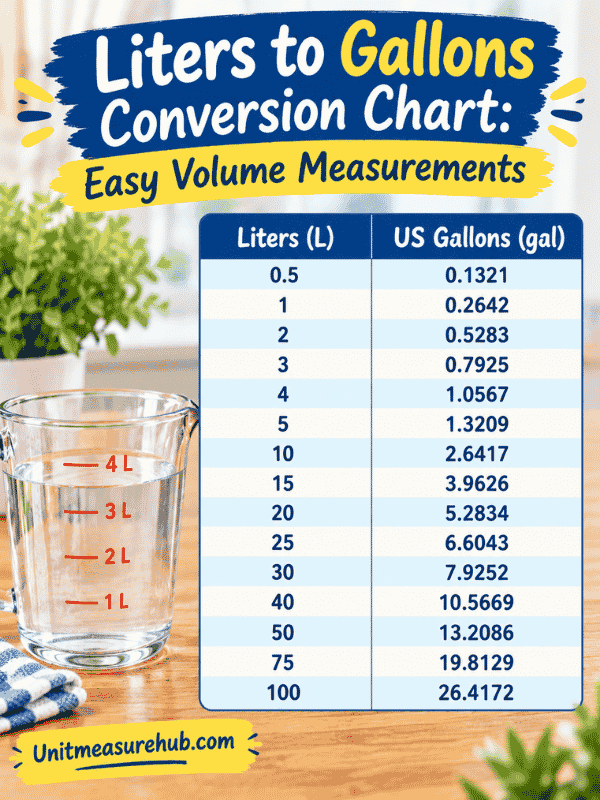
The full 1–100 table appears further down. If you need a bigger number, such as 500 or 1,000 liters, use the formula in the next sections.
Why a Chart Still Beats a Calculator Sometimes
- You are in a garage, kitchen, or warehouse with no signal.
- You want to compare several values at a glance.
- You print it and stick it near a fuel tank, pantry, or fish tank.
- You are teaching kids or new staff how volume units relate.
A good chart is also a sanity check. If your calculator says 50 liters is 132 gallons, a glance at the chart shows you slipped a decimal.
How to Convert Liters to Gallons
- Write down the volume in liters. Example: 12 liters.
- Decide which gallon you need. Use US gallons unless you are working in the UK or a country that uses imperial measures.
- Multiply by the conversion factor. For US gallons, use 0.264172.
- Round sensibly. Two to four decimals works for most tasks.
Example: 12 L × 0.264172 = 3.1701 US gallons.
The Division Method
You can also divide instead of multiply. One US gallon holds 3.78541 liters, so:
Gallons = Liters ÷ 3.78541
Both methods give the same result. Multiplication is usually faster on a phone. Division feels natural if you think “how many 3.785-liter jugs fit in this?”
A Mental Shortcut for Quick Estimates
You will not always have a device. Try this:
- Divide the liters by 4.
- Add about 6% to the answer.
Example: 40 liters ÷ 4 = 10. Add 6% (0.6) and you get 10.6. The exact answer is 10.57.
This trick is accurate enough for shopping, travel and casual cooking. Do not use it for lab work, chemical mixing or fuel billing.
Common Mistakes to Avoid
Mixing up the direction
Liters to gallons shrinks the number. Gallons to liters grows it.
Using the wrong gallon
US and imperial gallons differ by about 20%.
Rounding too early
Round at the end, not in the middle of multi-step math.
Confusing liters with milliliters
1,000 mL equals 1 L. Convert first if needed.
Liters to Gallons Conversion Formula
US gallons = liters × 0.264172052
For everyday use, 0.2642 is enough.
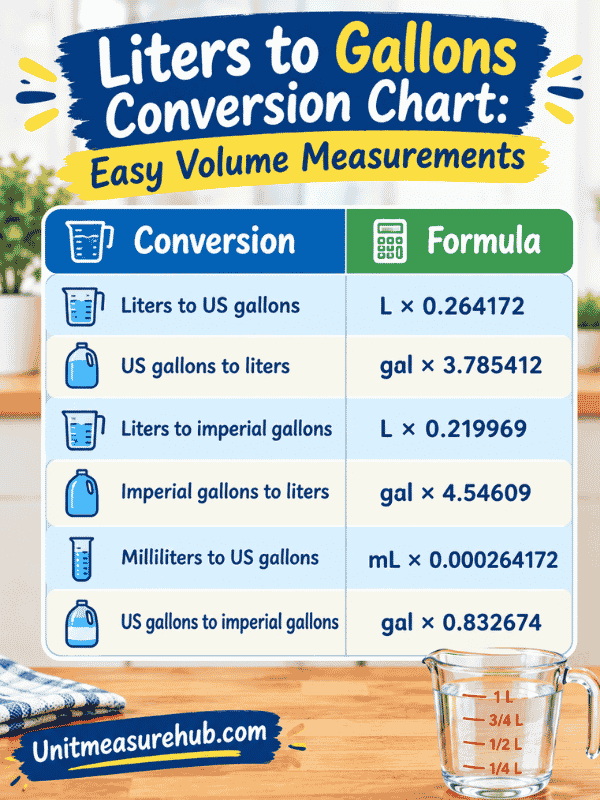
Where the Number 0.264172 Comes From
The US liquid gallon is legally defined as 231 cubic inches. That equals exactly 3.785411784 liters. Divide 1 by 3.785411784 and you get 0.264172052…
That is why you will see the factor written as 0.264172, 0.2642 or 0.26417. They are all the same number at different precision levels.
Spreadsheet Formula
If you work in Excel or Google Sheets, put your liters in cell A2 and use:
=A2*0.264172052
Drag it down the column to convert a whole list. You can also use =CONVERT(A2,”l”,”gal”). In Excel, the “gal” unit is the US liquid gallon.
Simple Code Version
For anyone building a tool or script:
gallons = liters * 0.264172052
Keep the full factor in code and round only when you display the result.
How Precise Should You Be?
| Use case | Suggested decimals |
| Cooking, drinks | 1–2 |
| Travel, fuel tanks | 1–2 |
| Aquariums, pools | 1–2 |
| Engineering, lab work | 4–6 |
| Fuel trade, pharma, chemicals | Use full precision, follow standards |
Liters to US Gallons Calculator
You do not need an app. Use this manual calculator method. It takes ten seconds.
Manual Calculator Steps
- Enter the number of liters.
- Press ×.
- Enter 0.264172.
- Press =.
That is your answer in US gallons.
Calculator Reference Table
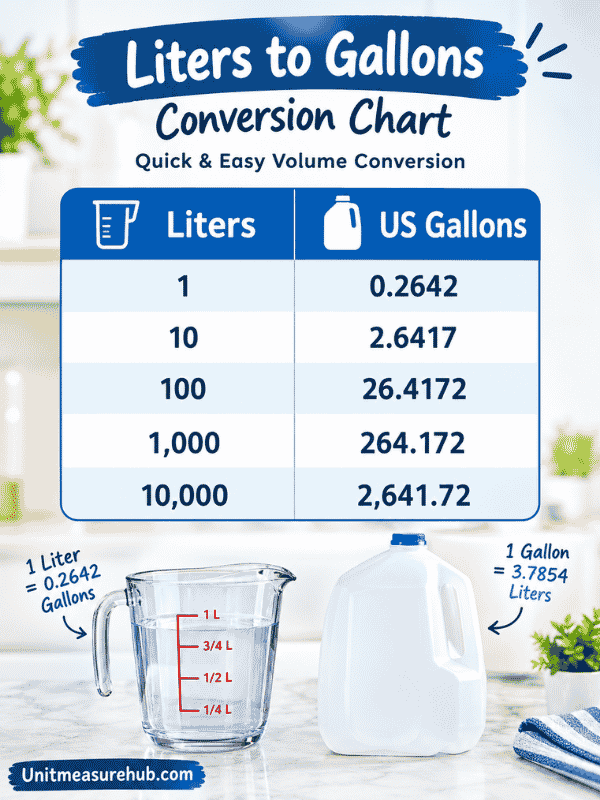
Example using building blocks: Convert 230 liters.
- 200 L = 52.834 gal
- 30 L = 7.925 gal
- Total = 60.759 gal
Each zero you add to the liters adds a zero’s worth of shift to the gallons. That makes mental scaling easy.
Reverse Calculator: Gallons to Liters
Need the opposite? Multiply gallons by 3.785412.
Example: 6 gal × 3.785412 = 22.71 L.
If you want a clickable calculator on your own site or sheet, the spreadsheet formula above works perfectly. I can also build an interactive converter for you if you would like one.
Liters to Gallons Conversion Table (1 to 100 Liters)
| Liters | US Gal | Liters | US Gal |
| 1 | 0.2642 | 51 | 13.4728 |
| 2 | 0.5283 | 52 | 13.7369 |
| 3 | 0.7925 | 53 | 14.0011 |
| 4 | 1.0567 | 54 | 14.2653 |
| 5 | 1.3209 | 55 | 14.5295 |
| 6 | 1.5850 | 56 | 14.7936 |
| 7 | 1.8492 | 57 | 15.0578 |
| 8 | 2.1134 | 58 | 15.3220 |
| 9 | 2.3775 | 59 | 15.5861 |
| 10 | 2.6417 | 60 | 15.8503 |
| 11 | 2.9059 | 61 | 16.1145 |
| 12 | 3.1701 | 62 | 16.3787 |
| 13 | 3.4342 | 63 | 16.6428 |
| 14 | 3.6984 | 64 | 16.9070 |
| 15 | 3.9626 | 65 | 17.1712 |
| 16 | 4.2268 | 66 | 17.4354 |
| 17 | 4.4909 | 67 | 17.6995 |
| 18 | 4.7551 | 68 | 17.9637 |
| 19 | 5.0193 | 69 | 18.2279 |
| 20 | 5.2834 | 70 | 18.4920 |
| 21 | 5.5476 | 71 | 18.7562 |
| 22 | 5.8118 | 72 | 19.0204 |
| 23 | 6.0760 | 73 | 19.2846 |
| 24 | 6.3401 | 74 | 19.5487 |
| 25 | 6.6043 | 75 | 19.8129 |
| 26 | 6.8685 | 76 | 20.0771 |
| 27 | 7.1326 | 77 | 20.3412 |
| 28 | 7.3968 | 78 | 20.6054 |
| 29 | 7.6610 | 79 | 20.8696 |
| 30 | 7.9252 | 80 | 21.1338 |
| 31 | 8.1893 | 81 | 21.3979 |
| 32 | 8.4535 | 82 | 21.6621 |
| 33 | 8.7177 | 83 | 21.9263 |
| 34 | 8.9818 | 84 | 22.1904 |
| 35 | 9.2460 | 85 | 22.4546 |
| 36 | 9.5102 | 86 | 22.7188 |
| 37 | 9.7744 | 87 | 22.9830 |
| 38 | 10.0385 | 88 | 23.2471 |
| 39 | 10.3027 | 89 | 23.5113 |
| 40 | 10.5669 | 90 | 23.7755 |
| 41 | 10.8310 | 91 | 24.0397 |
| 42 | 11.0952 | 92 | 24.3038 |
| 43 | 11.3594 | 93 | 24.5680 |
| 44 | 11.6236 | 94 | 24.8322 |
| 45 | 11.8877 | 95 | 25.0963 |
| 46 | 12.1519 | 96 | 25.3605 |
| 47 | 12.4161 | 97 | 25.6247 |
| 48 | 12.6803 | 98 | 25.8889 |
| 49 | 12.9444 | 99 | 26.1530 |
| 50 | 13.2086 | 100 | 26.4172 |
How Many Gallons Are in a Liter?
One liter equals 0.264172 US gallons
That is roughly one quarter of a gallon, a little more.
In imperial gallons, one liter equals 0.219969.
| Unit | Gallons in 1 liter |
| US liquid gallon | 0.264172 |
| Imperial (UK) gallon | 0.219969 |
| US dry gallon | 0.227021 |
Put It in Everyday Terms
- A 1-liter water bottle holds a bit over a quarter of a US gallon.
- Four 1-liter bottles hold slightly more than one US gallon (4 L = 1.057 gal).
- A US gallon needs about 3.8 one-liter bottles to fill.
The Reverse Question
People also ask how many liters are in a gallon:
- US gallon: 3.785 liters
- Imperial gallon: 4.546 liters
Keep these two numbers in your head. They cover about 90% of volume confusion.
Liters to US Liquid Gallons Conversion
What Makes a Gallon “Liquid”?
The US actually has two gallons:
- US liquid gallon: 231 cubic inches, or 3.785 liters.
- US dry gallon: about 268.8 cubic inches, or 4.405 liters. It is used rarely, mostly for historical measures of grain and produce.
If you are measuring gasoline, water, juice or cleaning solution, you want the liquid gallon.
The US Customary Ladder
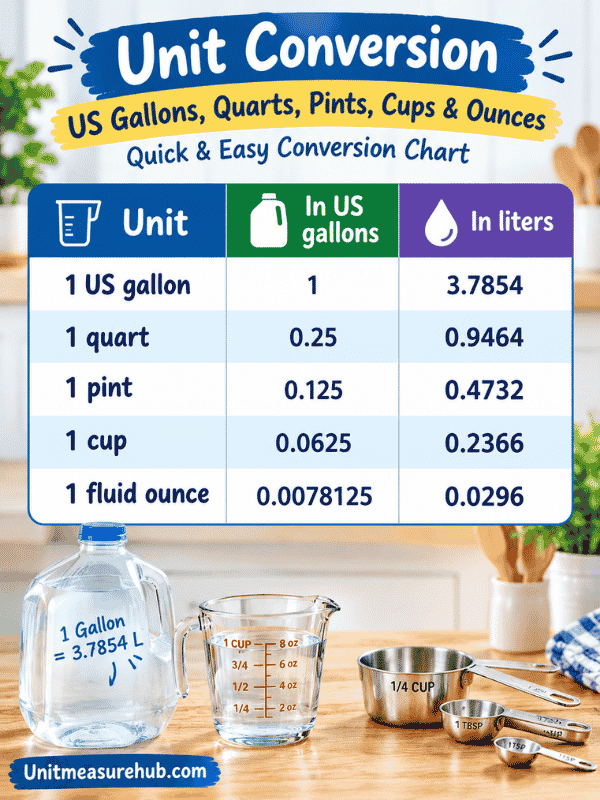
Liters to Gallons, Quarts and Pints Together
| Liters | US Gallons | US Quarts | US Pints |
| 1 | 0.2642 | 1.0567 | 2.1134 |
| 2 | 0.5283 | 2.1134 | 4.2268 |
| 3.785 | 1.0000 | 4.0000 | 8.0000 |
| 5 | 1.3209 | 5.2834 | 10.5669 |
| 10 | 2.6417 | 10.5669 | 21.1338 |
Liters to Gallons Conversion Examples
Example 1: A 2-Liter Soda Bottle
2 × 0.264172 = 0.528 US gallons. That is just over half a gallon.
Example 2: A 5-Liter Olive Oil Tin
5 × 0.264172 = 1.321 US gallons. About one gallon plus a little over a cup.
Example 3: A 150-Liter Water Heater
150 × 0.264172 = 39.63 US gallons. That is close to the common 40-gallon tank size sold in the US.
Example 4: A 60-Liter Aquarium
60 × 0.264172 = 15.85 US gallons. It is close to a standard 15-gallon tank, though not identical.
Example 5: A 240-Liter Rain Barrel
240 × 0.264172 = 63.40 US gallons.
Example 6: Cooking Stock for a Crowd
A European recipe asks for 8 liters of stock.
8 × 0.264172 = 2.11 US gallons. That is about 8.45 US quarts.
Example 7: A Paint Job
A paint can lists 10 liters of coverage. You want to buy US gallon cans.
10 × 0.264172 = 2.64 gallons. Buy three one-gallon cans, or one 2-gallon and two 1-gallon cans if you want a margin.
Example 8: Working Backward
You need 4 US gallons of solution. How many liters?
4 × 3.785412 = 15.14 liters.
Quick Practice Set
Try these, then check against the table above.
- 25 liters → ? gal
- 45 liters → ? gal
- 80 liters → ? gal
Answers: 6.60, 11.89 and 21.13.
Liters to Gallons Conversion Chart for Water
Water is the easiest liquid to convert because its weight lines up neatly with volume.
1 liter of water weighs about 1 kilogram. 1 US gallon of water weighs about 8.34 pounds (3.785 kg).
Water Conversion Table
| Liters | US Gallons | Approx. water weight |
| 1 | 0.264 | 1 kg / 2.2 lb |
| 5 | 1.321 | 5 kg / 11 lb |
| 10 | 2.642 | 10 kg / 22 lb |
| 20 | 5.283 | 20 kg / 44 lb |
| 50 | 13.209 | 50 kg / 110 lb |
| 100 | 26.417 | 100 kg / 220 lb |
| 200 | 52.834 | 200 kg / 441 lb |
Daily Drinking Water
Health guidance varies by person, climate and activity. Many adults aim for roughly 2 to 3 liters of fluids a day.
- 2 liters = 0.53 US gallons
- 3 liters = 0.79 US gallons
That means the popular “drink a gallon a day” challenge is about 3.8 liters, which is more than most people need. Talk to a doctor if you are unsure about your own intake.
Aquariums
Aquarium tanks are often labeled in gallons in the US and in liters elsewhere. Remember that the usable water volume is lower than the tank’s rated size because of gravel, rocks and decorations.
| Tank size (L) | Tank size (US gal) |
| 40 | 10.6 |
| 75 | 19.8 |
| 120 | 31.7 |
| 200 | 52.8 |
| 300 | 79.3 |
| 500 | 132.1 |
Pools, Hot Tubs and Water Tanks
Larger volumes are easier in cubic meters. One cubic meter holds 1,000 liters, or 264.17 US gallons.
| Volume | US Gallons |
| 1,000 L (1 m³) | 264.17 |
| 5,000 L | 1,320.86 |
| 10,000 L | 2,641.72 |
| 25,000 L | 6,604.30 |
A small hot tub of 1,500 liters holds about 396 US gallons.
Household Water Use
Households often track water use in liters per day and compare it to US reports in gallons.
- A 10-minute shower with a standard head can use roughly 80 to 95 liters, about 21 to 25 gallons. Actual use depends on flow rate.
- A toilet flush ranges from about 4.8 to 9 liters (1.3 to 2.4 gallons) depending on the model.
Liters to Gallons Conversion for Fuel and Gasoline
Fuel is where this conversion matters most for travelers and fleet owners. Most countries sell gasoline by the liter. The US sells it by the gallon.
Fuel Tank Size Table
| Tank size (L) | US Gallons |
| 30 | 7.93 |
| 35 | 9.25 |
| 40 | 10.57 |
| 45 | 11.89 |
| 50 | 13.21 |
| 55 | 14.53 |
| 60 | 15.85 |
| 70 | 18.49 |
| 80 | 21.13 |
| 100 | 26.42 |
Small cars often hold 35 to 50 liters. Large SUVs and pickups hold 70 to 100 liters or more.
Fuel Price Comparison
Prices are quoted per liter or per gallon, so compare them on the same basis.
Price per gallon = price per liter × 3.785
Example: If fuel costs 1.50 per liter, that equals 1.50 × 3.785 = 5.68 per gallon.
Price per liter = price per gallon ÷ 3.785
Example: 4.00 per gallon ÷ 3.785 = 1.06 per liter.
Always compare in the same currency. Exchange rates change daily.
Fuel Economy: L/100 km vs MPG
This is the other half of the fuel story. Most of the world measures consumption in liters per 100 kilometers. The US uses miles per gallon.
MPG (US) = 235.215 ÷ L/100 km
| L/100 km | MPG (US) | MPG (Imperial) |
| 4 | 58.8 | 70.6 |
| 5 | 47.0 | 56.5 |
| 6 | 39.2 | 47.1 |
| 7 | 33.6 | 40.4 |
| 8 | 29.4 | 35.3 |
| 10 | 23.5 | 28.2 |
| 12 | 19.6 | 23.5 |
| 15 | 15.7 | 18.8 |
Diesel, Jerry Cans and Generators
- A standard 20-liter jerry can holds 5.28 US gallons.
- A 10-liter can holds 2.64 gallons.
- A portable generator with a 15-liter tank holds 3.96 gallons.
If a generator manual says it burns 0.8 gallons per hour, a full 15-liter tank lasts about 4.95 hours at that load.
Fuel Safety Reminder
Only store fuel in approved containers, and fill to the manufacturer’s marked limit to allow for expansion. Do not trust a rough mental estimate when you are mixing two-stroke oil and fuel. Use the exact ratio from the equipment manual and convert carefully.
Difference Between US Gallons and Imperial Gallons
This section prevents the most expensive mistake in volume conversion.
A US gallon is 3.785 liters. An imperial gallon is 4.546 liters. The imperial gallon is about 20% larger.
Side-by-Side Comparison
| Feature | US liquid gallon | Imperial gallon |
| Volume in liters | 3.78541 | 4.54609 |
| Volume in cubic inches | 231 | about 277.42 |
| Quarts per gallon | 4 | 4 |
| Fluid ounces per gallon | 128 US fl oz | 160 imperial fl oz |
| Pints per gallon | 8 | 8 |
| Gallons in 1 liter | 0.264172 | 0.219969 |
| Used in | United States, some Caribbean and Latin American markets | UK (in some contexts), parts of the Caribbean |
| Water weight per gallon | about 8.34 lb | about 10.02 lb |
Why Two Gallons Exist
The US gallon traces back to the old English wine gallon. The imperial gallon came from the British Weights and Measures Act of 1824, which based it on the volume of 10 pounds of water. The US never adopted that change. Britain later moved to metric for most trade, but the imperial gallon remains in everyday talk, especially for fuel economy.
Imperial Gallon Conversion Table
| Liters | Imperial Gallons | US Gallons |
| 1 | 0.2200 | 0.2642 |
| 5 | 1.0998 | 1.3209 |
| 10 | 2.1997 | 2.6417 |
| 20 | 4.3994 | 5.2834 |
| 50 | 10.9985 | 13.2086 |
| 100 | 21.9969 | 26.4172 |
Converting Between the Two
- US gallons to imperial: multiply by 0.832674.
- Imperial gallons to US: multiply by 1.200950.
Example: 10 imperial gallons × 1.20095 = 12.01 US gallons.
Which One Should You Use?
- Reading a US source, recipe, manual or label? Use the US gallon.
- Reading a UK source, older car manual or British recipe? Check whether it means imperial.
- Not sure? Look at the fluid ounce count or ask the publisher. If a gallon is listed as 160 fl oz, it is imperial.
A mismatch of 20% can ruin a recipe, wreck a fuel plan or misdose a treatment product.
Common Liters to Gallons Conversions (5, 10, 20, 50 and 100 Liters)
5 Liters to Gallons
- 5 L = 1.3209 US gallons
- 5 L = 1.0998 imperial gallons
- 5 L = 5.28 US quarts
Common objects around 5 liters: a large cooking oil container, a small water jug, a large bag-in-box wine.
10 Liters to Gallons
- 10 L = 2.6417 US gallons
- 10 L = 2.1997 imperial gallons
- 10 L = 10.57 US quarts
Common objects: a standard bucket, a camping water container, a small jerry can.
20 Liters to Gallons
- 20 L = 5.2834 US gallons
- 20 L = 4.3994 imperial gallons
- 20 L = 21.13 US quarts
Common objects: a typical jerry can, a water cooler bottle (many are about 19 liters, or 5 gallons), a motorcycle fuel tank.
50 Liters to Gallons
- 50 L = 13.2086 US gallons
- 50 L = 10.9985 imperial gallons
- 50 L = 52.83 US quarts
Common objects: a mid-size car fuel tank, a large cooler, a mid-size aquarium.
100 Liters to Gallons
- 100 L = 26.4172 US gallons
- 100 L = 21.9969 imperial gallons
- 100 L = 105.67 US quarts
Common objects: a large SUV tank, a drum of cleaning product, a mid-size water butt.
Summary Table
| Liters | US Gal | Imp. Gal | US Quarts | US Pints |
| 5 | 1.3209 | 1.0998 | 5.2834 | 10.5669 |
| 10 | 2.6417 | 2.1997 | 10.5669 | 21.1338 |
| 20 | 5.2834 | 4.3994 | 21.1338 | 42.2675 |
| 50 | 13.2086 | 10.9985 | 52.8344 | 105.6688 |
| 100 | 26.4172 | 21.9969 | 105.6688 | 211.3376 |
Memorize Just Three Anchors
If you can only remember a few values, remember these:
- 1 L ≈ 0.264 gal
- 4 L ≈ 1.057 gal (a bit more than a gallon)
- 100 L ≈ 26.4 gal
From these you can estimate almost anything in your head.
Where This Conversion Matters in Real Life
- Travel: reading fuel pumps abroad and comparing prices.
- Cooking and baking: scaling recipes from metric cookbooks.
- Home improvement: paint, sealant and cleaning solution coverage.
- Gardening: irrigation, fertilizer mixing and rain barrel capacity.
- Pets and fish keeping: tank volume and treatment dosing.
- Camping and RVs: fresh water and gray water tank limits.
- Business: importing or exporting liquids, labeling and product specs.
- School: science and math homework involving unit conversion.
Tips for Accurate Conversions
- Write the unit next to every number. “12” is useless. “12 L” is clear.
- Say which gallon you mean in notes and spreadsheets.
- Keep the conversion factor in a labeled cell rather than retyping it.
- Double-check large values with a second method, such as the division method.
- For regulated work, follow the standard your industry requires.
Frequently Asked Questions
How many gallons are in a liter?
One liter equals 0.264172 US gallons, or 0.219969 imperial gallons.
How do you convert liters to gallons?
Multiply the liters by 0.264172 to get US gallons. You can also divide by 3.78541.
How many liters are in a gallon?
A US gallon has 3.785 liters. An imperial gallon has 4.546 liters.
What is 1 liter in gallons?
One liter is about 0.264 US gallons, a little more than a quarter gallon.
How many liters make 1 US gallon?
It takes 3.785 liters to make one US gallon.
What is 5 liters in gallons?
Five liters equals 1.3209 US gallons.
What is 10 liters in gallons?
Ten liters equals 2.6417 US gallons.
What is 20 liters in gallons?
Twenty liters equals 5.2834 US gallons.
What is 50 liters in gallons?
Fifty liters equals 13.2086 US gallons.
What is 100 liters in gallons?
One hundred liters equals 26.4172 US gallons.
Is a gallon bigger than a liter?
Yes. A US gallon is about 3.8 times larger than a liter.
Are US and UK gallons the same?
No. The UK imperial gallon is about 20% larger than the US gallon.
Is 4 liters equal to a gallon?
Almost. Four liters is 1.057 US gallons, about 6% more than one gallon.
Is a 2-liter bottle half a gallon?
Close, but slightly larger. Two liters is 0.528 US gallons, versus 0.5 for a half gallon.
How many liters of water should I drink in a gallon a day?
A gallon is 3.785 liters. Needs vary, so ask a healthcare professional what suits you.
How do I convert liters to gallons in Excel?
Use =A1*0.264172052 or =CONVERT(A1,”l”,”gal”).
How do I convert liters per 100 km to MPG?
Divide 235.215 by the L/100 km value to get US miles per gallon.
Also Read This Grams to Cups Conversion Chart: Easy Cooking Measurements
Conclusion
Converting liters to gallons is simple once you know the one number that matters: 1 liter = 0.264172 US gallons. Multiply by it, or divide by 3.785, and you are done.
Use the chart for fast checks, the 1–100 table for exact values, and the shortcut of dividing by 4 and adding about 6% when you need a quick estimate.
Remember the one trap: US and imperial gallons are not the same. Always confirm which one your source means, especially for fuel, recipes and product dosing.
Save this page, print the table, and keep the key numbers handy. Whether you are filling a tank, stocking an aquarium or scaling a recipe, you now have what you need to convert with confidence.

My name is simith .iam passionate writer With 4 years of experience, we make measurements easy and accurate. Our focus is on unit, length, and weight conversions. Our goal is to make everyday conversions quick and hassle-free.