
If you’ve ever stood in your kitchen holding a recipe that calls for “3/4 cup” when all you can find is a tablespoon, you already know why a reliable kitchen measurement conversion guide matters. Recipe measurements aren’t just fussy details cooks invented to make life harder they’re the difference between a cake that rises perfectly and one that collapses in the middle, or a sauce that tastes balanced instead of overwhelmingly salty.
Whether you’re doubling a family recipe for a holiday dinner, halving a dessert for two, or converting an international recipe written in milliliters and grams, understanding how cups, tablespoons, teaspoons, ounces, and metric units relate to each other will save you time, waste, and kitchen stress. This guide breaks down every common kitchen measurement conversion you’ll actually need, backed by simple charts, real-world context, and answers to the questions home cooks ask most.
Why Cooks Around the World Measure Differently
Part of the confusion around kitchen conversions comes from the fact that the world simply doesn’t agree on one measurement system. The United States still relies heavily on the imperial system — cups, tablespoons, teaspoons, and fluid ounces while most of the rest of the world, including the UK, Australia, and Europe, uses the metric system of grams, milliliters, and liters.
This split matters more than most people realize. A recipe developed in London and shared online might list “200g flour” and “250ml milk,” while an American recipe blog will call for “1 2/3 cups flour” and “1 cup milk.” Neither version is wrong they’re just speaking two different measurement languages. Once you know how to translate between them, you can cook from any cookbook or website in the world without hesitation.
Kitchen Measurement Conversion Chart
| Measurement | Equivalent |
| 1 tablespoon | 3 teaspoons |
| 1 tablespoon | 1/2 fluid ounce |
| 1/4 cup | 4 tablespoons |
| 1/3 cup | 5 tablespoons + 1 teaspoon |
| 1/2 cup | 8 tablespoons |
| 1 cup | 16 tablespoons |
| 1 cup | 8 fluid ounces |
| 1 cup | 240 milliliters |
| 2 cups | 1 pint |
| 4 cups | 1 quart |
| 4 quarts | 1 gallon |
| 1 fluid ounce | 2 tablespoons |
| 1 teaspoon | 5 milliliters |
Kitchen Measurement Conversion Guide for Cooking
Cooking measurements generally fall into two categories: volume (cups, tablespoons, teaspoons, fluid ounces, milliliters) and weight (ounces, grams, pounds, kilograms). Understanding which category a recipe is using and why is the first step toward accurate conversions.
Liquid vs. Dry Measuring Tools
One mistake many home cooks make is using the same measuring cup for both liquids and dry ingredients. While the volume is technically the same, the tools are designed differently:
- Liquid measuring cups have a spout for pouring and extra headspace at the top so liquid doesn’t spill when you carry it. You fill them to the marked line and read it at eye level.
- Dry measuring cups are meant to be filled to the brim and leveled off with a flat edge, giving you an exact, compact measurement of dry ingredients like flour or sugar.
Common Measurement Abbreviations
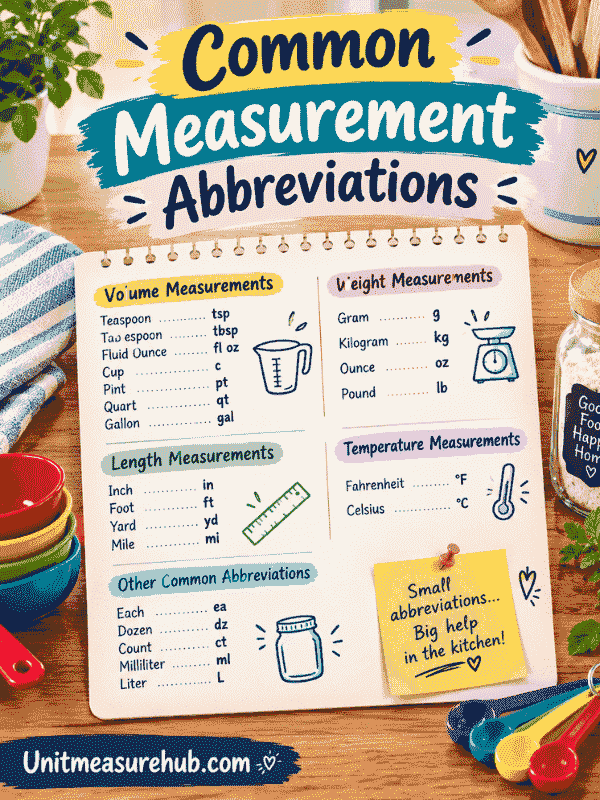
- tsp or t — teaspoon
- tbsp or T — tablespoon
- c or C — cup
- fl oz — fluid ounce
- oz — ounce (weight)
- lb — pound
- pt — pint
- qt — quart
- gal — gallon
- ml — milliliter
- l — liter
- g — gram
- kg — kilogram
Common Measurement Mistakes to Avoid
Scooping flour directly from the bag with a measuring cup
This compacts the flour and can add up to 20% more than the recipe intends. Instead, spoon flour into the cup and level it off with a knife.
Confusing fluid ounces with weight ounces
Eight fluid ounces of water weighs about eight ounces, but eight fluid ounces of honey or oil will weigh more because those liquids are denser.
Assuming all “cups” are the same size worldwide
A U.S. cup, a UK cup, and an Australian metric cup are all slightly different, which can cause small but real discrepancies in delicate recipes.
Eyeballing teaspoon and tablespoon measurements
Salt, baking powder, and spices are potent in small amounts, so guessing instead of measuring can throw off the entire flavor balance of a dish.
Ignoring ingredient density when converting weight to volume
A cup of chopped nuts weighs very differently from a cup of granulated sugar, even though the volume is identical.
Standard Measuring Spoon and Cup Sizes
Most measuring spoon sets include the following sizes, from smallest to largest:
- 1/8 teaspoon
- 1/4 teaspoon
- 1/2 teaspoon
- 1 teaspoon
- 1 tablespoon
Standard measuring cup sets typically include:
- 1/4 cup
- 1/3 cup
- 1/2 cup
- 1 cup
Cups to Tablespoons Conversion
| Cups | Tablespoons |
| 1/8 cup | 2 tablespoons |
| 1/4 cup | 4 tablespoons |
| 1/3 cup | 5 tablespoons + 1 teaspoon |
| 1/2 cup | 8 tablespoons |
| 2/3 cup | 10 tablespoons + 2 teaspoons |
| 3/4 cup | 12 tablespoons |
| 1 cup | 16 tablespoons |
If you remember that 1 cup equals 16 tablespoons, you can calculate almost any fraction of a cup by dividing 16 accordingly. For example, half of 16 is 8 tablespoons (1/2 cup), and a quarter of 16 is 4 tablespoons (1/4 cup).
Tablespoons to Teaspoons Conversion
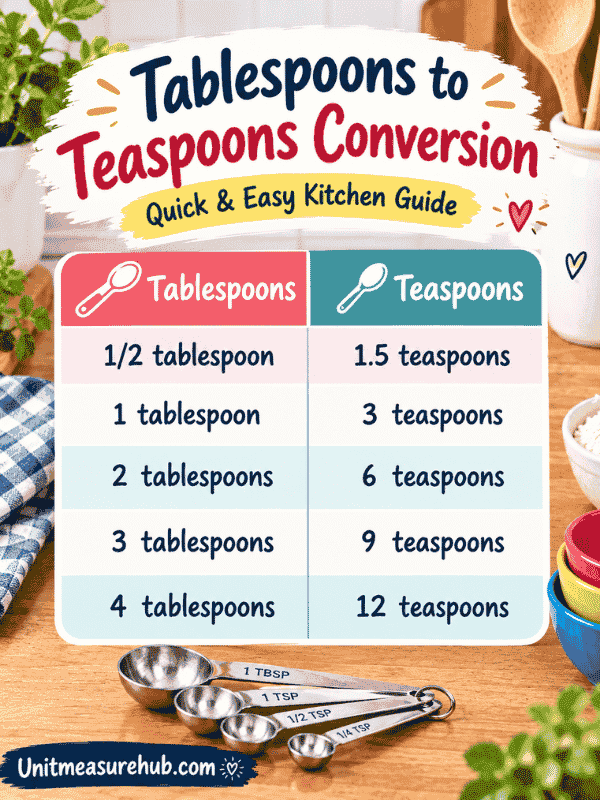
The golden rule to memorize: 1 tablespoon always equals 3 teaspoons. This single fact unlocks most tablespoon-to-teaspoon math without needing a chart at all.
Teaspoons to Cups Conversion
| Teaspoons | Cups |
| 12 teaspoons | 1/4 cup |
| 24 teaspoons | 1/3 cup |
| 36 teaspoons | 3/4 cup |
| 48 teaspoons | 1 cup |
Cups to Ounces Conversion
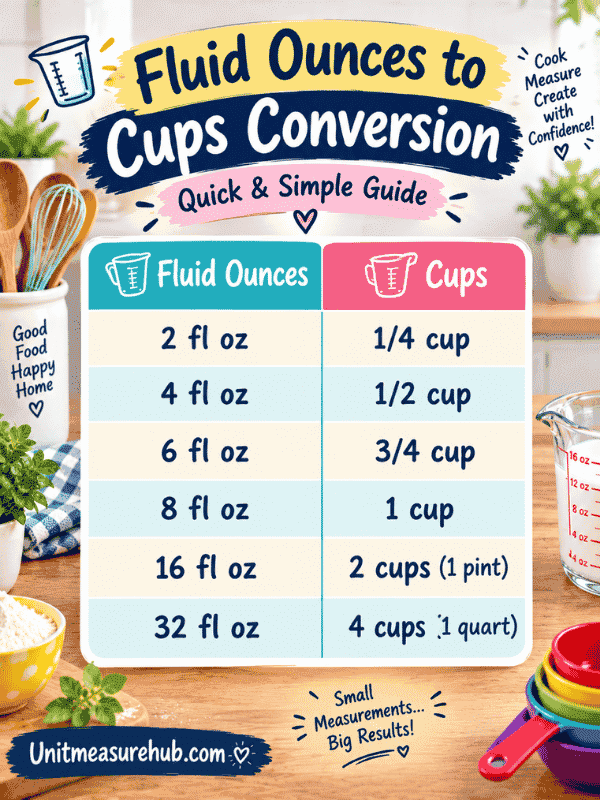
This conversion trips up a lot of home cooks because “ounces” can refer to either fluid ounces (a measure of volume) or weight ounces (a measure of mass). For most cooking purposes, especially with liquids, we’re talking about fluid ounces.
| Cups | Fluid Ounces |
| 1/4 cup | 2 fl oz |
| 1/3 cup | 2.7 fl oz |
| 1/2 cup | 4 fl oz |
| 3/4 cup | 6 fl oz |
| 1 cup | 8 fl oz |
| 2 cups | 16 fl oz |
Milliliters to Cups Conversion
If you’re following a recipe from outside the U.S. many British, Australian, and European recipes use the metric system you’ll need to convert milliliters into cups.
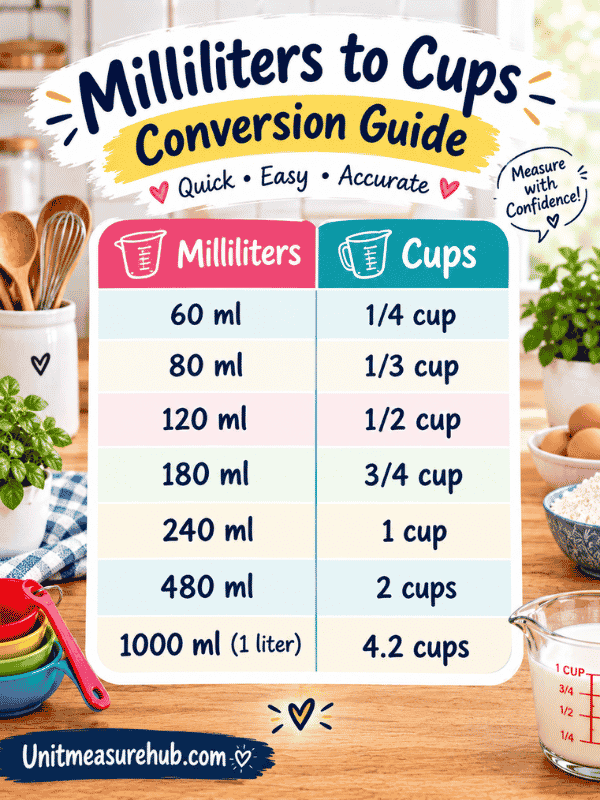
A U.S. cup is 240 ml, while a metric cup (used in Australia, the UK, and some other countries) is slightly different at 250 ml. The difference is small, but it can matter in precision baking, so double-check which system your recipe source uses.
Grams to Cups Conversion
Grams-to-cups conversions are the trickiest on this list because they depend entirely on the density of the ingredient being measured. Unlike volume-to-volume conversions (like cups to tablespoons), grams measure weight, and different ingredients pack differently into the same cup.
| Ingredient | 1 Cup (Approximate Weight) |
| All-purpose flour | 120–125 grams |
| Granulated sugar | 200 grams |
| Brown sugar (packed) | 220 grams |
| Butter | 227 grams |
| Powdered sugar | 120 grams |
| Rice (uncooked) | 185–200 grams |
| Almond flour | 96 grams |
| Cocoa powder | 85–90 grams |
Because these numbers vary by ingredient, the most reliable way to measure for baking is with a digital kitchen scale. Many professional bakers and recipe developers now list gram measurements alongside cups precisely because volume measurements can vary by 10-20% depending on how the ingredient is scooped, packed, or sifted.
If you bake often, an inexpensive digital kitchen scale is one of the best investments you can make. It removes the guesswork from grams-to-cups conversions and makes recipes far more repeatable, since most scales include a “tare” function that lets you zero out your mixing bowl and measure ingredients directly into it.
Teaspoons to Milliliters Conversion
| Teaspoons | Milliliters |
| 1/4 teaspoon | 1.25 ml |
| 1/2 teaspoon | 2.5 ml |
| 1 teaspoon | 5 ml |
| 2 teaspoons | 10 ml |
| 1 tablespoon (3 tsp) | 15 ml |
Fluid Ounces to Cups Conversion
Ounces to Grams Conversion for Recipes
| Ounces | Grams |
| 1 oz | 28 grams |
| 2 oz | 57 grams |
| 4 oz | 113 grams |
| 8 oz | 227 grams |
| 16 oz (1 lb) | 454 grams |
This conversion comes up constantly when following recipes for meat, cheese, chocolate, or pasta, since packaging in the U.S. is usually labeled in ounces or pounds, while international recipes list the same ingredients in grams or kilograms. If a recipe calls for 250 grams of chicken breast and your package is labeled in ounces, you’ll know to use just under 9 ounces (250 ÷ 28.35 ≈ 8.8 oz) to match the intended proportions.
How Many Cups Are in a Quart?
| Unit | Cup Equivalent |
| 1 cup | 1/4 quart |
| 2 cups | 1/2 quart (1 pint) |
| 4 cups | 1 quart |
| 8 cups | 2 quarts |
| 16 cups | 4 quarts (1 gallon) |
Essential Tools for Accurate Kitchen Measuring
- A set of dry measuring cups (1/4 cup through 1 cup) for flour, sugar, and other dry ingredients.
- A liquid measuring cup with a spout and clear markings, ideally in both cups and milliliters.
- A full set of measuring spoons, from 1/8 teaspoon to 1 tablespoon.
- A digital kitchen scale for weighing ingredients in grams or ounces, especially useful for baking.
- A liquid measuring jug large enough to handle quarts or liters for big-batch recipes like soups and stocks.
How to Convert Recipes When Scaling Up or Down
- Identify the scaling factor — doubling (×2), tripling (×3), or halving (×0.5) the recipe.
- Convert every ingredient using that factor, one at a time, rather than doing it all in your head at once.
- Watch non-linear ingredients, like baking soda, baking powder, and salt — they don’t always scale perfectly, so start slightly lower and adjust to taste.
- Recalculate pan size and bake time. Doubling a batter often means a larger pan or two pans, plus a slightly different bake time.
- Double-check odd fractions. Halving 1/3 cup gives 2 tablespoons plus 2 teaspoons easy to miscalculate without a chart.
Also Read This Inches to Feet Conversion Chart, Formula & Calculator
Frequently Asked Questions
How many tablespoons are in 1/4 cup?
There are 4 tablespoons in 1/4 cup.
How many teaspoons are in a tablespoon?
One tablespoon equals exactly 3 teaspoons.
Is a dry cup the same as a liquid cup?
The volume is identical, but the measuring tools differ dry cups are leveled off, while liquid cups have a pour spout and are read at eye level.
How many ounces are in a cup of flour?
A cup of all-purpose flour weighs about 4.25 to 4.5 ounces, though this can vary slightly based on how it’s scooped.
What is the difference between a fluid ounce and a regular ounce?
A fluid ounce measures volume (liquid), while a regular ounce measures weight — they aren’t interchangeable for solid ingredients.
How many milliliters are in a tablespoon?
One tablespoon equals 15 milliliters.
How do I convert a recipe from metric to U.S. measurements?
Use a conversion chart like this one, or apply key formulas: 1 cup = 240 ml, 1 tablespoon = 15 ml, and 1 ounce = 28 grams.
Why do baking recipes recommend weighing ingredients in grams?
Weighing removes the variability of scooping and packing, giving far more consistent and accurate results than volume measuring alone.
How many cups are in a pint?
There are 2 cups in 1 pint.
Can I use a regular spoon instead of a measuring spoon?
It’s not recommended, since regular spoons vary widely in size and can throw off ingredient ratios, especially in baking.
How many cups are in a gallon?
There are 16 cups in 1 gallon.
Does 1 cup of water weigh the same as 1 cup of flour?
No 1 cup of water weighs about 8 ounces, while 1 cup of flour weighs closer to 4.25 to 4.5 ounces because flour is far less dense.
What’s the easiest way to convert a recipe from ounces to cups?
Divide the number of fluid ounces by 8, since 8 fluid ounces always equals 1 cup.
Why do American and metric cup measurements differ slightly?
A U.S. cup is defined as 240 ml, while a metric cup used in countries like Australia and the UK is 250 ml, a small but sometimes significant difference in precise baking.
Also Read This Teaspoons to Tablespoons Conversion: Chart, Formula & Calculator
Conclusion
Kitchen measurement conversions might seem like a small detail, but they’re one of the most practical skills any home cook can master. Once you understand the relationships between cups, tablespoons, teaspoons, ounces, milliliters, and grams, you’ll be able to scale recipes up or down, follow international cooking instructions, and troubleshoot baking problems with far more confidence.
Keep this guide bookmarked as your go-to kitchen measurement conversion chart, whether you’re converting cups to tablespoons for a quick dinner recipe or figuring out how many cups are in a quart for a big batch of soup. With these charts and tips in hand, guesswork in the kitchen becomes a thing of the past and your recipes will turn out right, every single time.

My name is simith .iam passionate writer With 4 years of experience, we make measurements easy and accurate. Our focus is on unit, length, and weight conversions. Our goal is to make everyday conversions quick and hassle-free.