
You see a road sign that says 80 km to the next town. Your rental car shows speed in miles per hour. Or your running app logs 10 kilometers while your friend in Chicago talks in miles. Sooner or later, everyone needs a quick km to miles conversion.
The good news is that it takes one step. 1 kilometer equals 0.621371 miles. Multiply your kilometers by that number and you have the answer.
This guide gives you a clean kilometers to miles conversion chart, the formula, a mental-math shortcut, calculator steps and real examples. It also covers running, walking and why the United States still uses miles. You can bookmark it, print the tables or use it for homework.
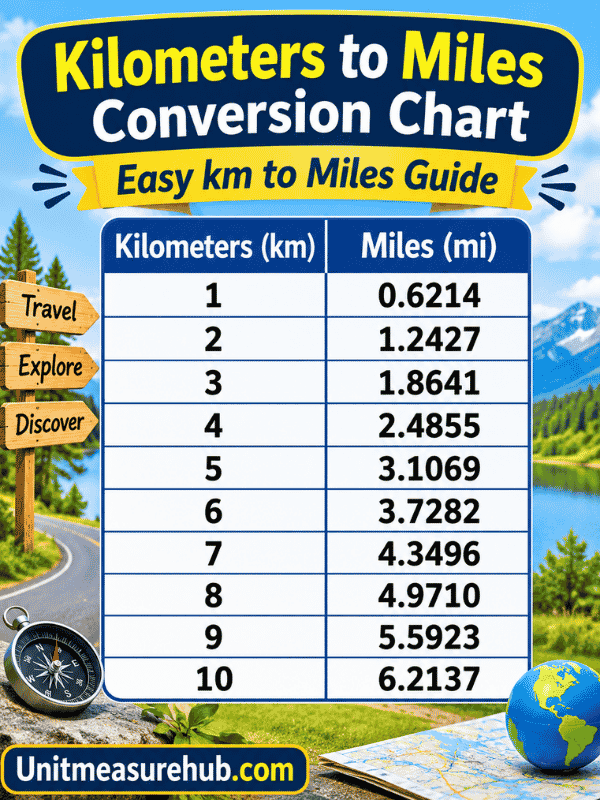
Kilometers to Miles Conversion Chart (1 to 10 km)
How to Convert Kilometers to Miles Easily
You have three practical ways to do this. Pick the one that fits the moment.
Method 1: Multiply by 0.621371
This is the exact method. It works for any number, whole or decimal.
- Write down the distance in kilometers.
- Multiply it by 0.621371.
- Round the result to the precision you need.
Method 2: Divide by 1.609344
A mile is exactly 1.609344 kilometers, so dividing gives the same answer.
Example: 15 ÷ 1.609344 = 9.3206 miles.
Use multiplication when you can. Most people find it easier on a phone calculator.
Method 3: Use the mental-math shortcut
When you are driving or walking and need a rough figure, try this:
- Take your kilometers.
- Multiply by 6.
- Move the decimal one place to the left.
- Add a small bump of about 2%.
Example: 50 km. 50 × 6 = 300. Move the decimal to get 30. Add 2% (0.6), and you get roughly 30.6. The exact answer is 31.07, so the estimate is close enough for planning.
A second trick uses the Fibonacci sequence: 3, 5, 8, 13, 21, 34. Each number is roughly the miles in the next number’s kilometers. So 5 miles is about 8 km, 8 miles is about 13 km, and 13 miles is about 21 km. It looks like magic, but it works because the ratio between neighboring Fibonacci numbers is close to 1.618, and the kilometers-per-mile ratio is 1.609.
Kilometers to Miles Formula Explained
Miles = Kilometers × 0.621371
Or in reverse:
Kilometers = Miles × 1.609344
Where does 0.621371 come from?
It is not an arbitrary number. Since 1959, the international mile has been defined as exactly 1,609.344 meters. A kilometer is exactly 1,000 meters. Divide 1,000 by 1,609.344 and you get 0.621371192…
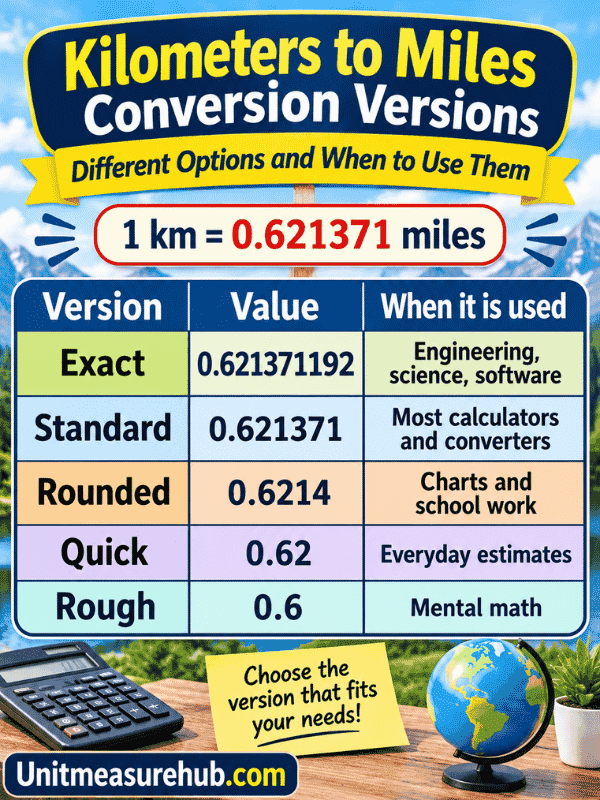
If a chart uses 0.6, it is a simplification. For anything where precision matters, such as a race course measurement or a shipping document, use at least 0.621371.
A worked example, step by step
Say you want to convert 37 km to miles.
- Start with 37.
- Multiply: 37 × 0.621371 = 22.9907.
- Round to two decimals: 22.99 miles.
Check it with the shortcut. 37 × 0.6 = 22.2, plus about 3% is roughly 22.9. It matches.
Why it always works
Distance is a straight-line relationship. Double the kilometers and you double the miles. That makes conversion easy to check. If 10 km is 6.21 miles, then 20 km must be 12.43 miles, and 100 km must be 62.14 miles.
Quick Kilometers to Miles Conversion Table
| Kilometers (km) | Miles (mi) |
| 10 | 6.21 |
| 20 | 12.43 |
| 30 | 18.64 |
| 40 | 24.85 |
| 50 | 31.07 |
| 60 | 37.28 |
| 70 | 43.50 |
| 80 | 49.71 |
| 90 | 55.92 |
| 100 | 62.14 |
Kilometers to Miles Calculator: Convert km to mi Instantly
Using a phone or desktop calculator
- Open the calculator app.
- Type the kilometers.
- Press the multiply key.
- Enter 0.621371.
- Press equals.
Using a search engine
Type something like “25 km to miles” into Google or another search engine. A built-in converter appears at the top of the results. It is handy when you are online and want a number in two seconds.
Using a spreadsheet
In Excel or Google Sheets, type your kilometers in cell A1 and put this in B1:
=A1*0.621371
You can also use the built-in function:
=CONVERT(A1,”km”,”mi”)
When to trust a calculator and when not to
Calculators are accurate if the factor is right. Some basic ones round the factor to 0.62, which creates small errors on long distances. At 1,000 km, using 0.62 gives 620 miles instead of 621.37. That is a gap of about 1.4 miles.
Common Kilometer to Mile Conversions (1, 5, 10, 50, 100 km)
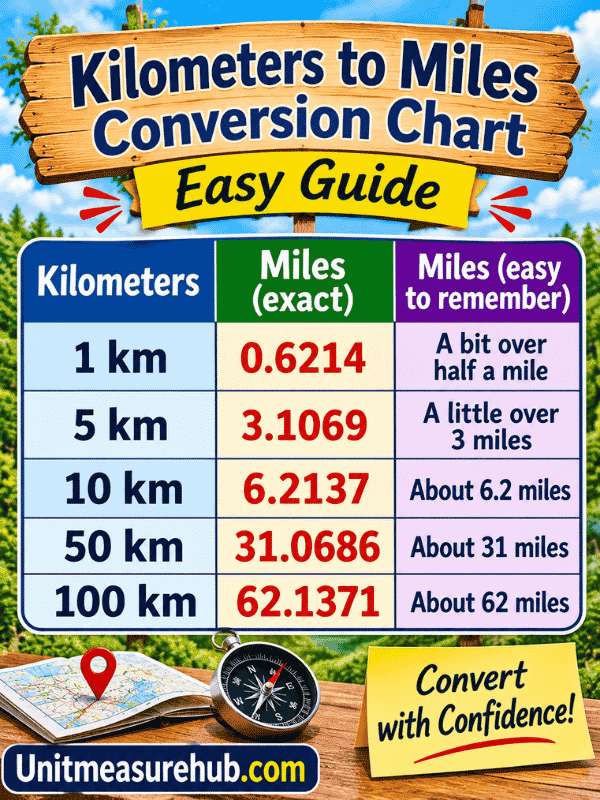
- 1 km is roughly 0.6 miles.
- 5 km is roughly 3.1 miles.
- 10 km is roughly 6.2 miles.
- 100 km is roughly 62 miles.
1 Kilometer to Miles: Exact Conversion Explained
1 kilometer = 0.621371192 miles.
For daily use, say 0.62 miles or 0.6214 miles.
What does 1 km look like?
It helps to picture the distance:
- About 1,000 meters
- Roughly 3,281 feet
- Around 1,094 yards
- Roughly 10 football fields, end to end
- A brisk walk of 10 to 12 minutes
- About 2.5 laps around a standard 400-meter running track
1 mile in kilometers
1 mile = 1.609344 kilometers. Most people round it to 1.61 km.
| Unit | In meters | In feet | In yards |
| 1 kilometer | 1,000 | 3,280.84 | 1,093.61 |
| 1 mile | 1,609.344 | 5,280 | 1,760 |
5 km, 10 km, and 20 km to Miles Conversion
These are three of the most searched distances, partly because of running events.
5 km to miles
5 × 0.621371 = 3.107 miles
This is the classic “5K” race. In miles, it is just over 3.1.
10 km to miles
10 × 0.621371 = 6.214 miles
The “10K” is another popular road race. It is just over 6 miles.
20 km to miles
20 × 0.621371 = 12.427 miles
You will see 20 km in long training runs, cycling routes and some city commuting distances.
Side-by-side summary
| Distance | Miles | Rounded | Approximate walking time at 5 km/h |
| 5 km | 3.107 | 3.1 | 1 hour |
| 10 km | 6.214 | 6.2 | 2 hours |
| 20 km | 12.427 | 12.4 | 4 hours |
Quick check for each
- 5 km: Half of 10 km, so half of 6.21 is 3.11.
- 10 km: Multiply by 6, shift the decimal, add a little. You get about 6.2.
- 20 km: Double 10 km. 6.21 × 2 = 12.43.
50 km, 100 km, and 500 km to Miles Conversion Chart
| Kilometers | Miles | Typical use |
| 50 km | 31.07 | A day of cycling, a short highway trip |
| 100 km | 62.14 | A “century” ride is 100 miles, so this is a “metric century” |
| 200 km | 124.27 | A long day’s drive |
| 300 km | 186.41 | A regional trip between two cities |
| 400 km | 248.55 | A half-day on the highway |
| 500 km | 310.69 | A full day of driving for many people |
| 1,000 km | 621.37 | A cross-country leg |
50 km to miles
50 × 0.621371 = 31.07 miles. A decent estimate is “a bit over 30.”
100 km to miles
100 × 0.621371 = 62.14 miles. This is one of the easiest numbers to remember.
500 km to miles
500 × 0.621371 = 310.69 miles. A rough check: 500 × 0.6 = 300, plus a little, so about 310.
Driving time estimates
| Speed (km/h) | Speed (mph) |
| 50 | 31 |
| 80 | 50 |
| 100 | 62 |
| 110 | 68 |
| 120 | 75 |
| 130 | 81 |
Kilometers to Miles Conversion for Running and Walking
Standard race distances
| Race | Kilometers | Miles |
| 1K fun run | 1 | 0.62 |
| 3K | 3 | 1.86 |
| 5K | 5 | 3.11 |
| 10K | 10 | 6.21 |
| 15K | 15 | 9.32 |
| 10 miles | 16.09 | 10 |
| Half marathon | 21.0975 | 13.11 |
| Marathon | 42.195 | 26.22 |
A marathon is usually quoted as 26.2 miles, which is the rounded figure. The more precise value is 26.2188 miles.
Converting pace
Pace is where mix-ups happen. A runner who does 5:00 per kilometer is running 8:03 per mile. The math is simple: multiply the minutes per kilometer by 1.609344.
| Pace (min/km) | Pace (min/mile) |
| 4:00 | 6:26 |
| 4:30 | 7:15 |
| 5:00 | 8:03 |
| 5:30 | 8:51 |
| 6:00 | 9:39 |
| 6:30 | 10:27 |
| 7:00 | 11:16 |
Converting speed
| km/h | mph |
| 8 | 4.97 |
| 10 | 6.21 |
| 12 | 7.46 |
| 14 | 8.70 |
| 16 | 9.94 |
Walking
Most adults walk at about 4 to 5.5 km/h on flat ground. That is roughly 2.5 to 3.4 mph.
A few examples of how this plays out:
- A 5 km walk (3.1 miles) takes about an hour.
- A 10,000-step day is usually somewhere between 7 and 8 km, depending on stride. That is about 4.3 to 5 miles.
- A 2 km walk to the shops is about 1.24 miles.
Kilometers vs Miles: What’s the Difference?
Both are units of distance. They belong to different measurement systems.
| Feature | Kilometer (km) | Mile (mi) |
| System | Metric (SI) | Imperial / US customary |
| Based on | The meter | Historical Roman and English units |
| Equals | 1,000 meters | 1,609.344 meters |
| Subdivision | Decimal (meters, centimeters) | Yards, feet, inches |
| Where used | Most of the world | United States, UK roads, a few others |
| Symbol | km | mi |
Why the metric system is easier to calculate
The metric system runs on powers of ten. A kilometer is 1,000 meters, and a meter is 100 centimeters. You move the decimal point and you are done.
Miles are messier. A mile is 1,760 yards, 5,280 feet or 63,360 inches. Those numbers have no simple decimal logic.
A short history
The word kilometer comes from the metric system created in France in the 1790s. The meter was originally defined using a fraction of the distance from the equator to the North Pole. The kilometer simply multiplied it by a thousand.
The mile has older roots. It comes from the Roman mille passus, meaning a thousand paces. Over the centuries, English law adjusted the length. The statute mile of 5,280 feet became the standard in England in the 1500s.
A note on spelling
You will see both kilometer and kilometre. American English uses “kilometer.” British, Australian and Canadian English use “kilometre.” The unit and the symbol are the same.
Which is “better”?
Neither is better in a technical sense. They measure the same thing. The metric system is simply more consistent, which is why science, medicine and most of the world’s industry rely on it.
Why Does the USA Use Miles Instead of Kilometers?
This is one of the most common questions behind a km to miles search. The answer is a mix of history, timing and public attitude.
Inheritance from Britain
The American colonies used English units. When the United States became independent, it kept them. Metric measurements only appeared in France in the 1790s, and the young US had other priorities.
Missed opportunities
The United States did not ignore the metric system entirely. In 1866, Congress made it legal to use metric units in trade. In 1875, the US was one of the original signers of the Treaty of the Meter. In 1893, a government order began defining American customary units, like the yard and the pound, in terms of the meter and the kilogram. So even American “miles” are tied to the metric system behind the scenes.
The 1970s push
The Metric Conversion Act of 1975 declared metric measurement the preferred system for US trade and commerce. But the program was voluntary. A Metric Board was set up, and by 1982 it had been shut down for lack of funding.
Highway signs were a good example of what went wrong. A few states posted kilometer signs in the late 1970s. Public pushback was strong, and the plan faded.
Cost and habit
Changing a nation’s measurements means changing road signs, textbooks, tools, machinery, packaging and everyday habits. For a large country with a huge built environment, the price is significant. And because people grow up with miles, there is little everyday pressure to switch.
Other countries that still use miles
The United Kingdom is the best-known example. British road signs show distances in miles and speeds in mph, even though much of daily life there is metric. A few other places, such as Liberia and Myanmar, are often mentioned as holdouts in general metric-system discussions. Always check current local rules if you are driving abroad.
The takeaway
America uses miles because of legacy and habit, not because anyone chose them as the better system. Science, medicine, the military and many industries in the US already use metric. Road distances and everyday speech are the main places where miles remain.
Kilometers to Miles Conversion Examples in Everyday Life
Conversion questions are rarely abstract. Here are real situations where this skill comes in handy.
Travel and road trips
You are driving in Canada, where signs are in kilometers, but your phone’s maps app is set to miles.
- A sign says “Toronto 120 km.” That is 74.6 miles.
- A speed limit of 100 km/h is 62 mph.
- A speed limit of 50 km/h in a town is 31 mph.
If you rent a car in Europe and your US habits are strong, the shortcut of “multiply by 0.6” will keep you from guessing wrong.
Fuel economy
Cars worldwide quote efficiency in different ways. In many countries, it is liters per 100 km. In the US, it is miles per gallon (mpg). The two use different units on both sides, so conversion takes extra steps. You will still start with the kilometer-to-mile piece.
Fitness apps and wearables
Smartwatches and apps like Strava let you choose units. If you follow a coach in Europe and track runs in miles, you will convert often. A 12 km long run is 7.46 miles.
Cycling
Cycling clubs in many countries use kilometers for route length. A 160 km ride is about 99.4 miles, which is why a “century” challenge can be met with a 161 km ride.
Flights and shipping
Aviation uses nautical miles, a third unit. A nautical mile is 1.852 km, or about 1.15 statute miles. Do not mix the two. If a document says “nm,” it is not the same as “mi.”
School and homework
Students often get problems like this:
A bus travels 45 km. How many miles is that?
Solution: 45 × 0.621371 = 27.96 miles.
Real estate and maps
Property listings and travel guides may tell you a beach is “8 km from the center.” That is about 5 miles, a short drive or a long bike ride.
Quick everyday cheat list
| Situation | km | Miles |
| Walk to a nearby cafe | 1.5 | 0.93 |
| Daily commute | 25 | 15.5 |
| Airport transfer | 40 | 24.9 |
| Weekend drive | 150 | 93.2 |
| Day trip | 300 | 186.4 |
Common Mistakes to Avoid
Multiplying by the wrong number
Use 0.621371 for km to miles. Use 1.609344 for miles to km. Swapping them gives a wildly wrong answer.
Forgetting which result should be bigger
Miles should always be fewer than kilometers for the same distance. If your answer is larger, you used the wrong factor.
Rounding too early
Round only at the end of a multi-step problem.
Mixing nautical and statute miles
They are different units.
Confusing speed and distance
km/h converts to mph with the same factor, but the context changes.
Frequently Asked Questions
How many miles are in 1 kilometer?
There are 0.621371 miles in 1 kilometer, usually rounded to 0.62.
How do you convert km to miles?
Multiply the kilometers by 0.621371. For a quick estimate, multiply by 0.6 and add a little.
What is the formula for kilometers to miles?
Miles = Kilometers × 0.621371.
How many miles is 5 km?
5 km equals about 3.11 miles.
How many miles is 10 km?
10 km equals about 6.21 miles.
How many miles is 100 km?
100 km equals about 62.14 miles.
Is a kilometer longer than a mile?
No. A mile is longer, at about 1.609 kilometers.
How many kilometers are in a mile?
One mile equals exactly 1.609344 kilometers.
What is the easiest way to convert km to miles in your head?
Multiply by 6, move the decimal one place left, then add about 2%.
How many miles is a marathon in kilometers?
A marathon is 42.195 km, or about 26.2 miles.
How many miles is 100 km/h?
100 km/h is about 62 mph.
Why does the US still use miles?
The US inherited British units and never completed a nationwide switch, partly because of cost and habit.
Also Read This Feet to Meters Conversion Chart: Easy ft to m Measurements
Conclusion
Converting kilometers to miles comes down to one number: 0.621371. Multiply, round and you are done. For quick estimates, remember that 1 km is a little over half a mile, 5 km is about 3.1 miles, 10 km is about 6.2 miles and 100 km is about 62 miles.
Keep the tables above close for running, driving and trip planning. Use the mental-math shortcut when you are on the move and the exact factor when accuracy counts. Once you have a few anchor values memorized, you will rarely need a calculator.
Save this page, print the chart or share it with someone who is planning a trip or training for a race.

My name is simith .iam passionate writer With 4 years of experience, we make measurements easy and accurate. Our focus is on unit, length, and weight conversions. Our goal is to make everyday conversions quick and hassle-free.